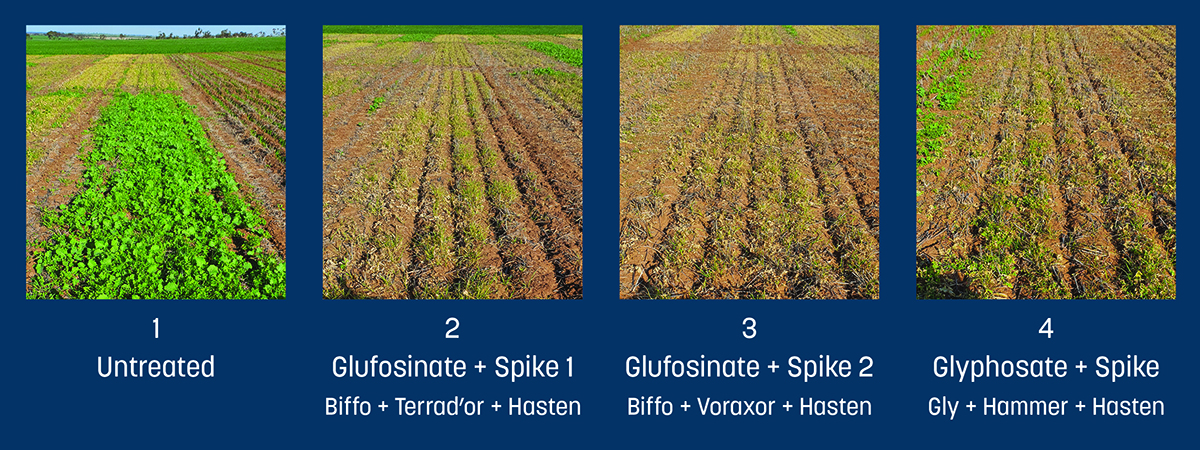
Reinventing the pre-seeding double-knock tactic

The double-knockdown tactic is a key component of the WeedSmart Big 6 strategy, which aims to keep weed numbers low, preserve herbicide efficacy and give competitive crops a head start.
Research and development in the early 2000s in NSW and Western Australia proved that using the double-knock tactic could almost double the effective life of glyphosate before glyphosate resistance begins to build in a population of annual ryegrass.
Field trials also showed that this ‘one-two punch’ tactic effectively controls glyphosate-resistant plants within an annual ryegrass population.
However, with the recent surge in glyphosate and paraquat resistance in annual ryegrass, it is reasonable to ask whether the ‘glyphosate followed by paraquat double-knock’ is still a useful pre-seeding weed control tactic.
In broadacre cropping systems, paraquat-resistant ryegrass was confirmed in 2019, and ryegrass with dual resistance to glyphosate and paraquat was confirmed in 2022 in Western Australia. Nearly 50 paraquat-resistant ryegrass populations have since been confirmed, and according to Dr Sam Kleeman from Plant Science Consulting, most of these samples have also tested positive for glyphosate resistance.
As growers prepare for sowing winter crops, Dr Chris Preston, Professor of Weed Management at The University of Adelaide, says there are some alternatives to consider if the glyphosate and or paraquat resistance is increasing in the annual ryegrass seed bank in some paddocks.
“The double-knock principle is still a valuable tool within a diverse weed control strategy,” he says. “We need to look at potentially introducing a different set of herbicide components and application timings in some situations.”
One option is to apply glyphosate pre-seeding followed by paraquat with a Voraxor spike mixed with a pre-emergent herbicide, such as Overwatch, Mateno Complete, Reflex or Boxer Gold at sowing.
“Another pre-seeding double-knock option is to apply glufosinate followed by glyphosate 14 days later,” says Chris. “The glufosinate is applied first because it has a 14-day plant back window and will remove some of the weed leaves, so it is necessary to wait for new growth before applying glyphosate.”
Chris says that glufosinate has not been widely used in broadacre grain production because it is not as effective on ryegrass as paraquat or glyphosate.
“Glufosinate is similar in many ways to glyphosate, but it also has some important differences that affect how it is used,” he says. “Understanding how this herbicide is absorbed and translocated in the weed target will help growers achieve the best result possible.”
Both glyphosate and glufosinate are negatively charged herbicides, so their absorption into leaves is slow. Both herbicides are absorbed more readily when humidity is high, but this is even more critical for glufosinate than glyphosate.
Applying glufosinate in the morning, when humidity is usually higher, slows the drying of the droplet and allows more time for the herbicide to be absorbed. For example, in a trial where ryegrass plants were sprayed with glufosinate and then placed in two humidity environments for the next 24 hours, 50 per cent of the plants in the low (76%) humidity setting survived, while only 10 per cent of the plants maintained in high (90%) humidity conditions survived.
Glufosinate needs daylight for uptake and translocation, so do not apply this herbicide at night. Morning is usually the best time to apply glufosinate to gain the maximum benefit of higher humidity and light intensity.
“Once absorbed, glufosinate is slower to translocate through the plant than glyphosate,” says Chris. “For example, translocation of glufosinate in annual ryegrass is half that of wild oats, which makes annual ryegrass harder to control. In addition, translocation is further impaired if there are cool conditions on the days after spraying.”
Because the translocation of glufosinate is slower, using a high water rate (over 100 L/ha) will improve herbicide efficacy.
Finally, application to small weeds improves control because the herbicide has less distance to translocate with small weeds.
In summary, high water rates, daylight, warm temperatures and high humidity combine to give glufosinate the best chance of maximum absorption by extending the time the droplet stays on the leaf before drying. Adding ammonium sulphate to lower the water pH also aids the uptake of glufosinate into plant leaves. Where there is a rate range on the herbicide label, the highest rate should be used under most circumstances to improve glufosinate performance.
The double-knock principle within the WeedSmart Big 6 can take many forms and can include non-herbicide components. Mitigating herbicide resistance relies on eliminating survivor weeds and preventing seed set.
GRDC code: UCS2008-001RTX, UOA2007-007RTX
More resources
- GRDC Update: Double and triple-knock strategies for managing ryegrass
- AHRI Snapshot: Knock, knock
- Can I win against ryegrass with dual resistance to glyphosate and paraquat
- What are the options to manage glyphosate and paraquat resistant ryegrass