Cotton HRMS

Cotton HRMS

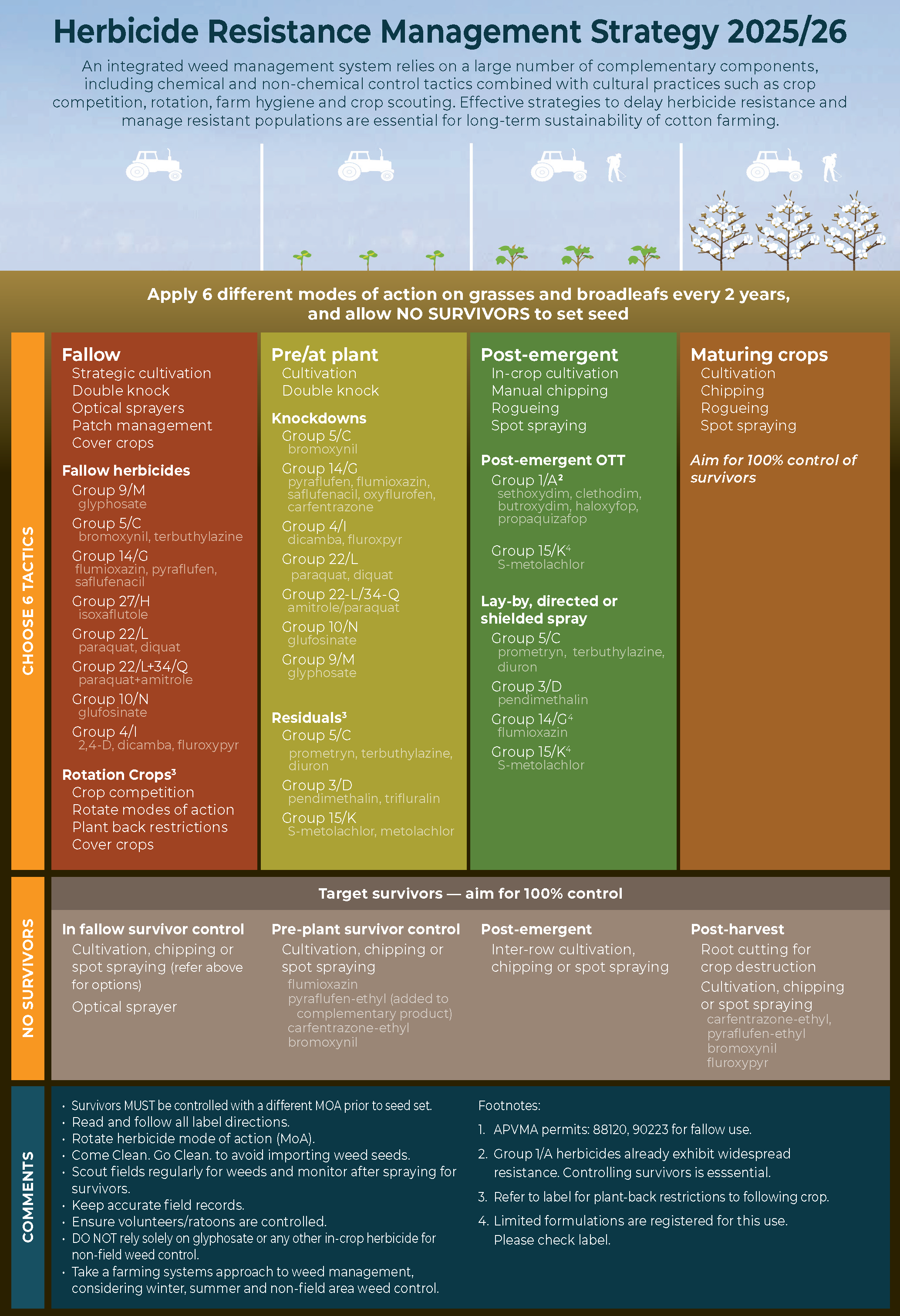
The Herbicide Resistance Management Strategy (HRMS) draws together available information, enabling growers and agronomists to understand and manage the risks of herbicide resistance in Australian cotton farming systems.

HRMS for irrigated and dryland cotton, fallow and rotational crops

The HRMS enables you to determine which other weed control tactics can be incorporated into your management system by providing guidance on how much extra time they will give you until resistance develops, and demonstrating the effect they will have on the weed seed bank, which is critical to effectively managing resistance.

Implementing the HRMS in cotton requires fitting a range weed control tactics into real situations with lots of variables. Finding room for 6 different tactics every two years is feasible but can be challenging.

A few of the important considerations are:

  • What weed species are you actually dealing with?
  • What’s your crop rotation?
  • When, and how often, can you include soil disturbance for weed management?

Tables B and C include some example IWM strategies in-crop and during fallows, rated for resistance risk and seedbank control. The most diverse strategies (at the top of each table) maximise seedbank control and minimise resistance risk, but potentially have the highest input costs. In order to fit the HRMS requirements of 6 different tactics every 2 years, aim for a strategy similar to those in the green rows (low or low-moderate risk). Avoid high or very high risk strategies where possible, and remember that if high risk strategies are used in one part of your rotation (e.g. in-crop), you’ll need an even greater focus on reducing risk in the following year to reach the HRMS target.

Non-cropping areas and the HRMS
Areas adjacent to cotton fields such as irrigation channels, head ditches, tail drains, roadways, fence lines and areas next to stock routes can be a significant entry source for resistant weed seeds. Where possible, use a range of tactics to manage weeds in these areas, and do NOT rely on glyphosate to manage weeds in these areas. Prevent survivors of herbicide application from setting seed.

This section is extracted from the 2025-26 Cotton Pest Management Guide.

Access the whole publication on the CottonInfo website.

Download Factsheet
Related Articles

View all
Article
News

Boosting knockdown efficacy against hard-to-kill weeds

Complex fallow weed spectrums and herbicide resistance profiles require more diversity in the double-knock tactic. Read More...
Article
Ask an Expert

Does weed detection and spot-spraying machinery pay off?

A new boomspray decision tool from WeedSmart is now available to test real-world spot-spraying technology options before spending any money. Read More...
Article
Ask an Expert

Is crop rotation an economic option for managing weeds?

Adding a broadleaf break crop to the cropping sequence helps keep wheat profitable in a sustainable cropping system. Read More...

Webinars

View all
Video
Webinar

Rise of the Machines: How to Invest in the Right Spray Technology for You!

Join our next webinar to find out what you should be considering before investing in new spray tech! Read More...
Video
Webinar

The good, the bad & the ugly

Learn all about the good, bad & ugly uses of residuals in the northern farming region! Read More...
Video
Webinar

Managing fenceline weeds (and avoiding resistance!)

Jana Freebairn to discuss fence line weed resistance trends, and how they are best managed through herbicide and non-herbicide options. Read More...

Videos

View all
Video
Webinar

Rise of the Machines: How to Invest in the Right Spray Technology for You!

Join our next webinar to find out what you should be considering before investing in new spray tech! Read More...
Video
Video

Narrow Windrow Burning

Whether you're new to narrow windrow burning or a seasoned veteran, you'll learn something new in this refresher video! Agronomists Emily Chambers and Peter Newman cover how to know when burning will be useful, how to get the best weed seed kill and how to manage the fire. Read More...
Video
Webinar

The good, the bad & the ugly

Learn all about the good, bad & ugly uses of residuals in the northern farming region! Read More...

Factsheets

View all
Fact Sheet

Smart rotations: Farming systems for the future

A brief history of research on crop and pasture rotations, an outline of the potential benefits from pasture-crop and crop-crop combinations. Read More...
Fact Sheet

Research paper: Strategic tillage in Australian conservation agricultural systems to address soil constraints

Growers who understand the impacts of soil amelioration on weed demography, can better plan weed management strategies to apply after tillage. Read More...
Fact Sheet

Research paper: Strategic tillage in conservation agricultural systems of north-eastern Australia

Experiments to quantify the risks and benefits to crop productivity, soil and environmental health of strategic tillage in no-till system. Read More...
Fact Sheet

The economics of precision weed management

The right spot-spray technology can help reduce the risks and impact of herbicide resistance, and potentially reduce costs. Read More...

Subscribe to the WeedSmart Newsletter