


Narrow windrow burning puts weed seeds in their place

Narrow windrow burning was the first harvest weed seed control method proven to kill weed seeds.
Research in the early 2000s demonstrated that burning narrow windrows of weed seed-laden crop residue (chaff and straw) at high temperatures for just 30 seconds killed even tough seeds like wild radish.
This weed control method is cheap and easy to implement and was widely adopted in regions where resistance to in-crop herbicides was evident.
Fast-forward twenty years, and narrow windrow burning has largely been replaced with chaff-only harvest weed seed control tactics, such as impact mills, chaff decks and chaff-lining. However, a spike in weed numbers in some areas in South Australia has prompted a renewed interest in narrow windrow burning to help reset the weed seedbank after a string of difficult years.
WeedSmart’s extension agronomist, Emily Chambers, based in Freeling, South Australia, says a number of growers in the Mid North region were looking for a way to react quickly to high annual ryegrass numbers present late in the 2025 season, without investing in specialised equipment. Many had limited recent experience with narrow windrow burning as an effective harvest weed seed control tactic.
“Although setting up for narrow windrow burning is fairly straightforward, it has been several years since it was widely implemented. I was keen to learn more about the essential factors for successful weed control using this tactic, and to share that information with growers,” she says. “In 2026, there have been several rain events that have interfered with burning the narrow windrows from last season’s harvest, but research has shown that burning after rain can still achieve effective weed seed control.”
Peter Newman, WeedSmart extension agronomist, was involved in the early research in collaboration with Dr Michael Walsh (formerly with AHRI and now CSU) and grower innovation in harvest weed seed control – a Western Australian invention. As growers are preparing to burn narrow windrows put down last harvest, possibly for the first time in many years, Peter is keen to see them succeed.
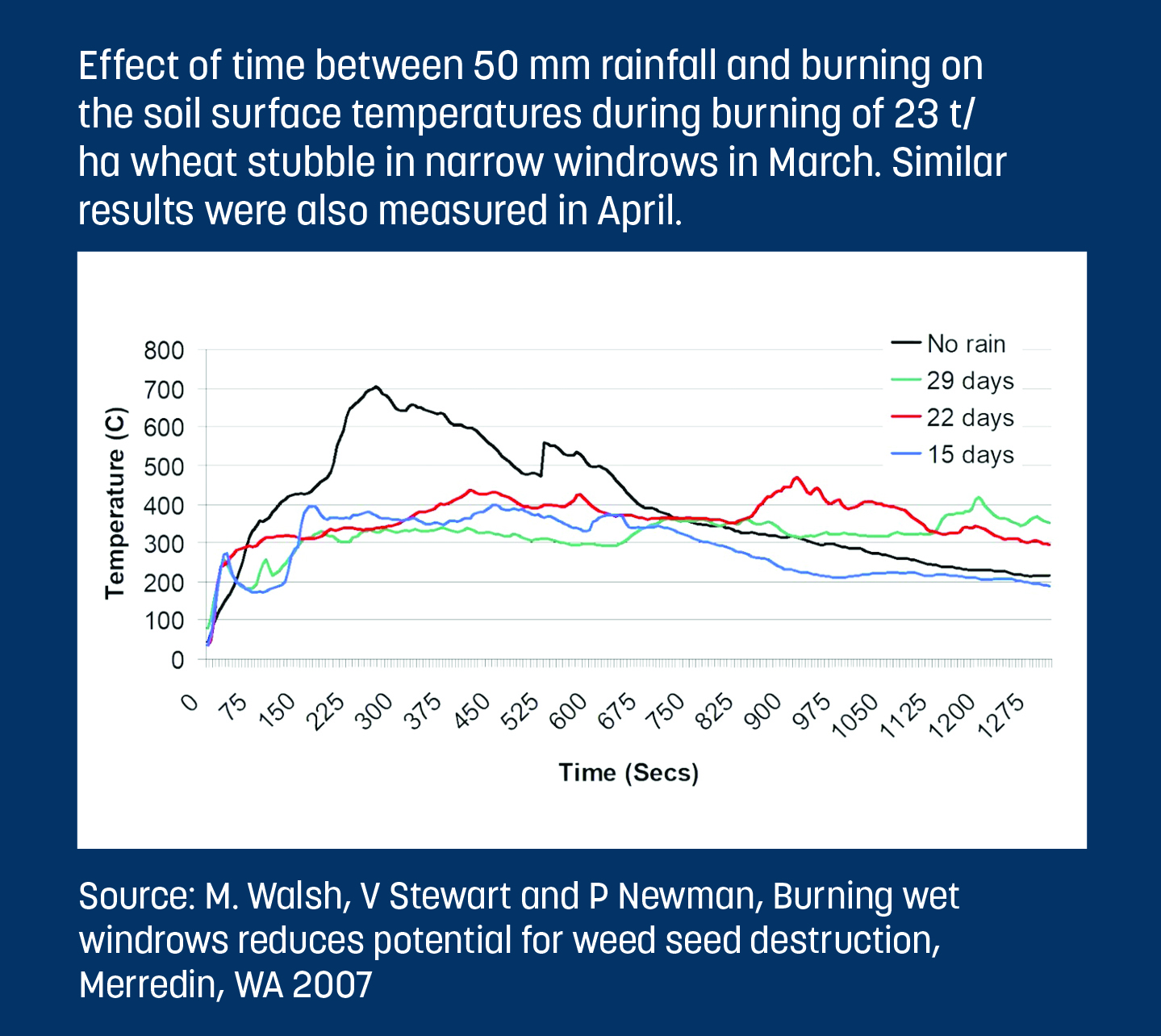
“To kill weed seeds in a narrow windrow, the temperature at the soil surface must reach 400 degrees Celsius for at least 10 seconds for grass seeds and 30 seconds for hard-coated seeds like wild radish,” he says. “A narrow windrow that is 600 to 700 mm wide has a high density of fuel and can sustain a hot fire for long enough to kill the weed seed present.”
For comparison, research by Dr Michael Walsh showed that stubble burning a paddock with 6 t/ha of crop residue will kill around 70–80 per cent of the annual ryegrass seed, but only 10 per cent of the wild radish seed. If a narrow windrow chute was used at harvest in the same paddock, the density of fuel in the windrows is 40 t/ha, which will maintain a hot fire long enough to kill all weed seed types.
Peter says the best time to burn narrow windrows is just before seeding your winter crops. Research has shown that narrow windrow fires generate mostly ash, which doesn’t tie up pre-emergent herbicides, and the windrows will maintain their integrity even if there is rain before burning.
“Burning the windrows before the autumn rain arrives is ideal and supports the hottest fires,” says Peter. “But field trials demonstrated that burning two weeks or more after rain had fallen on the windrows still provided effective weed seed control. Rain can compact the windrows somewhat, and they burn well with less risk of escapes.”
Some areas of South Australia have received significant and consistent rainfall over February and March, limiting the opportunity for narrow windrows to dry out. Emily expects that weed seed control may be compromised in some paddocks.
When preparing to burn, the first step is to burn the two outside laps to create a firebreak. A light cross breeze, 10 to 15 km/hr, provides the safest and most effective conditions to set the fires. Lighting the windrows at multiple points 200 m apart speeds up the process.
“The best crops for narrow windrow burning are 1.5 to 2.5 t/ha cereal crops, with extra caution required in barley crops, which are usually leafier and prone to fire escapes,” says Peter.
The recent shift to more direct heading of canola presents some challenges for narrow windrowing in this phase of the rotation. If canola is cut low and windrowed pre-harvest, narrow windrowing will provide effective weed control, but harvesting high will generally leave too much grass seed in situ, rather than collected into the narrow windrows.
Emily sees an opportunity for narrow windrow burning to combat clethodim-resistant ryegrass seedbanks in South Australian lentil crops. Since lentils are always harvested low, which also maximises the number of weed seeds that enter the header front, they are a good candidate for harvest weed seed control. As lentils are a low-biomass crop, Emily suggests further narrowing the windrow chute to concentrate the residue and support an effective burn to kill the weed seeds.
In Western Australia, Peter says growers have had success with narrow windrowing in lupins, provided the harvest operation itself is done carefully, with regular removal of dust from the header.
Although narrow windrow burning is a cost-effective tactic, its regular use will redistribute some nutrients, such as potassium, into bands within the paddock. This can have a detrimental effect on subsequent crops in soils that are naturally deficient in potassium. Since it is not generally practical to implement narrow windrow burning across the whole cropping program, Peter suggests using this tactic strategically within the crop rotation to suit the weed seed burden, the crop and the paddock.
Harvest weed seed control is one of the WeedSmart Big 6 pillars, being a valuable non-herbicide tactic to help drive down weed seed numbers. All of the proven methods available provide a similar level of weed seed destruction, and some growers use different harvest weed seed control methods in different crops. WeedSmart’s HWSC cost analysis tool allows growers to compare the commercially available harvest weed seed control tools, including impact mills, chaff decks, chaff lining, chaff carts, bale-direct and narrow windrow burning.
This video provides more detail from Emily and Peter.
Other resources
AHRI Research paper: Burning wet windrows
Access the HWSC cost estimate tool
These grower case studies are from several years ago, but they provide insights into the grower’s narrow windrow burning practice at the time:
