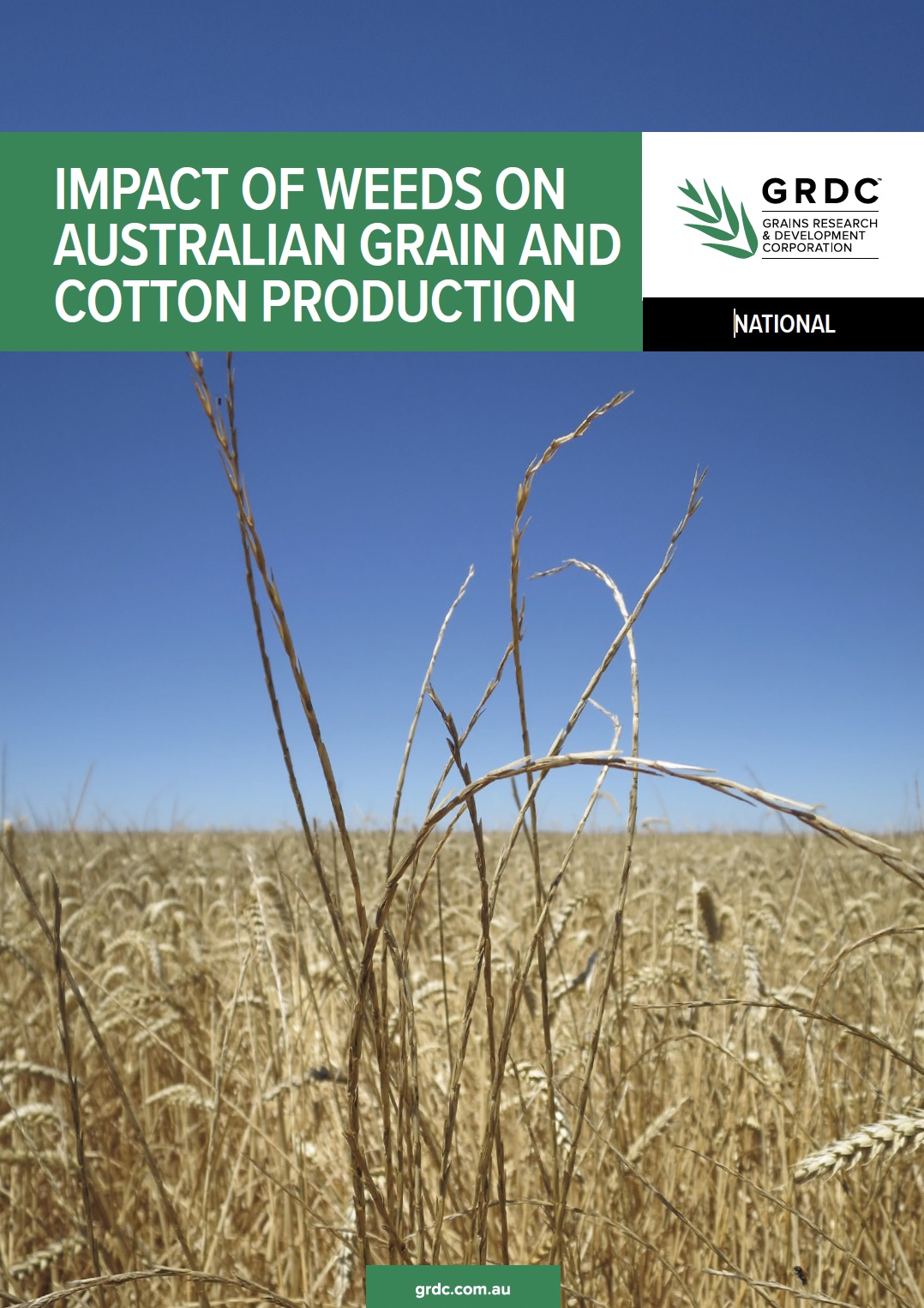
Impact of weeds on Australian grain and cotton production

Weeds cost Australian grain and cotton growers $4.43 billion annually in losses and control. Growers continue to invest heavily in weed management, mostly through herbicide-based methods, and continue to minimise yield losses due to in-crop weed populations.
Key points (annual)
- The overall cost of weeds to Australian grain and cotton growers is estimated to be $4434 million (an average of $206 per hectare) in weed control and crop losses.
- Expenditure and losses in grain crops is $4289 million (average $203/ha), while in cotton crops it is $145 million (average $445/ha).
- Expenditure on weed control in grain and cotton crops, including herbicide and non-herbicide practices, is estimated to average $180/ha. Average expenditure is $176/ha in grain crops and $387/ha in cotton.
- Yield losses due to weeds amounted to 1.2 million tonnes of grain.
- Nationally, in terms of cost, the major weeds in grain crops are ryegrass, brome grass, sow thistle, wild radish and wild oats. These results demonstrate the ongoing dominance of ryegrass as the most costly weed to Australian broadacre cropping.
- The study estimates $637 million is spent on fallow weed control through herbicide application: $611 million in grain crops ($29/ha) and $26 million in cotton ($80/ha).
- Weeds in fallows are still estimated to be costing more than $261 million through reduced crop yields ($111 million) and extra fertiliser requirements ($150 million).
- Nationally, the fallow weeds most costly to grain production are melons, heliotrope / potato weed and fleabane, while in cotton they are heliotrope / potato weed, wild turnip and windmill grass.
- Overall, in-crop residual weed densities were found to be typically low due to the major investment in managing weeds and maintaining low-weed seedbanks. Average revenue loss due to weed populations reducing crop yields (in-crop and fallow) was $24/ha.
Notable similarities and differences between these results and those found a decade earlier include the following:
- Expenditure dominates the overall cost of weeds relative to the costs incurred through yield loss.
- Herbicide use contributes to more than 70 per cent of all expenditure.
- Revenue losses due to yield reductions from fallow weeds are lower than in the 2016 study, reflecting increasing management attention to fallow weed control.
- Top fallow weeds are similar and include melons, heliotrope / potato weed and fleabane.
- The top residual weed in grain crops is annual ryegrass. Brome grass was a weed of rising importance in 2016 and has now become the second-costliest weed.
Yield loss costs due to in-crop weed competition ($516 million) are much lower than total weed management costs ($3857 million). This is despite increasing herbicide resistance and major shifts in cropping systems in many regions, such as increased early and dry seeding that does not allow for substantial pre-crop weed control. Increased investment in the widened range of pre-emergent herbicides and, in some cases, herbicide tolerant crops has been an enabling factor.
This report was compiled CSIRO researchers Jackie Ouzman, Masood Azeem and Rick Llewellyn. It follows on from and expands a similar report published in 2016 outlining the weed costs in grain production.
How to cite this report: Ouzman J, Azeem M, Llewellyn R (2025) Impact of weeds on Australian grain and cotton production. Grains Research and Development Corporation. pp 66. Accessible at: grdc.com.au
GRDC Code: CSP2307-001RTX
Download Factsheet