Research paper: Diverse systems to manage herbicide-resistant annual ryegrass

Research paper: Diverse systems to manage herbicide-resistant annual ryegrass
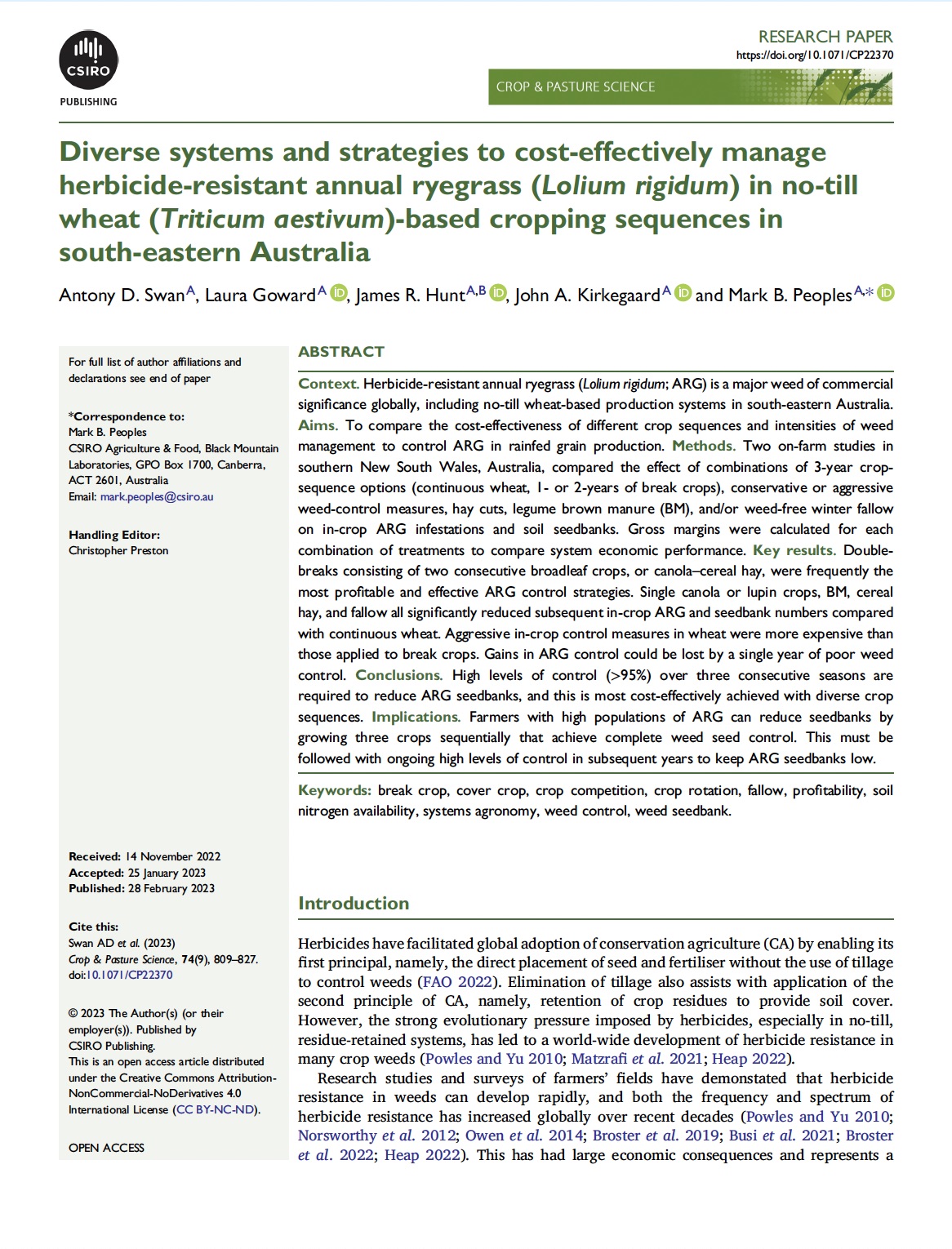
Diverse systems and strategies to cost-effectively manage herbicide-resistant annual ryegrass (Lolium rigidum) in no-till wheat (Triticum aestivum)-based cropping sequences in south-eastern Australia 

Antony D. SwanA, Laura GowardA , James R. HuntA,B, John A. KirkegaardA  and Mark B. PeoplesA

ACSIRO, BUniversity of Melbourne

Context: Herbicide-resistant annual ryegrass (Lolium rigidum; ARG) is a major weed of commercial significance globally, including no-till wheat-based production systems in south-eastern Australia.

Aims: To compare the cost-effectiveness of different crop sequences and intensities of weed management to control ARG in rainfed grain production.

Methods: Two on-farm studies in southern New South Wales, Australia, compared the effect of combinations of 3-year crop-sequence options (continuous wheat, 1- or 2-years of break crops), conservative or aggressive weed-control measures, hay cuts, legume brown manure (BM), and/or weed-free winter fallow on in-crop ARG infestations and soil seedbanks. Gross margins were calculated for each combination of treatments to compare system economic performance.

Key results: Double-breaks consisting of two consecutive broadleaf crops, or canola–cereal hay, were frequently the most profitable and effective ARG control strategies. Single canola or lupin crops, BM, cereal hay, and fallow all significantly reduced subsequent in-crop ARG and seedbank numbers compared with continuous wheat. Aggressive in-crop control measures in wheat were more expensive than those applied to break crops. Gains in ARG control could be lost by a single year of poor weed control.

Conclusions: High levels of control (>95%) over three consecutive seasons are required to reduce ARG seedbanks, and this is most cost-effectively achieved with diverse crop sequences.

Cite this: Swan AD et al. (2023) Crop & Pasture Science, 74(9), 809–827. doi:10.1071/CP22370

Related resources

Science backs double-breaks to beat annual ryegrass

Can a diverse farming system be profitable and hard on weeds?

Download Factsheet
Related Articles

View all
Article
Ask an Expert

Using residuals to keep irrigation infrastructure and borders weed-free

A robust residual herbicide program on non-crop areas buys growers time in the peak periods and reduces weed numbers for routine maintenace. Read More...
Article
News

Resistance risk to eliminate herbicides on irrigated farms

While cotton paddocks are generally relatively weed-free, the incidence of glyphosate resistance continues to increase for several key weeds. Read More...
Article
News

Narrow windrow burning puts weed seeds in their place

Narrow windrow burning was the first harvest weed seed control method. It's still an effective and cheap way to kill weed seeds. Read More...

Webinars

View all
Video
Webinar

Fighting Fleabane!

Replay this webinar for a cross-country look at what is and isn’t working for fleabane control in each growing region. Read More...
Video
Webinar

Rise of the Machines: How to Invest in the Right Spray Technology for You!

Join our next webinar to find out what you should be considering before investing in new spray tech! Read More...
Video
Webinar

The good, the bad & the ugly

Learn all about the good, bad & ugly uses of residuals in the northern farming region! Read More...

Videos

View all
Video
Webinar

Fighting Fleabane!

Replay this webinar for a cross-country look at what is and isn’t working for fleabane control in each growing region. Read More...
Video
Webinar

Rise of the Machines: How to Invest in the Right Spray Technology for You!

Join our next webinar to find out what you should be considering before investing in new spray tech! Read More...
Video
Video

Narrow Windrow Burning

Whether you're new to narrow windrow burning or a seasoned veteran, you'll learn something new in this refresher video! Agronomists Emily Chambers and Peter Newman cover how to know when burning will be useful, how to get the best weed seed kill and how to manage the fire. Read More...

Factsheets

View all
Fact Sheet

Integrated weed management of flaxleaf fleabane

Effective control of flaxleaf fleabane requires a combination of cultural, chemical and mechanical strategies. Read More...
Fact Sheet

Smart rotations: Farming systems for the future

A brief history of research on crop and pasture rotations, an outline of the potential benefits from pasture-crop and crop-crop combinations. Read More...
Fact Sheet

Research paper: Strategic tillage in Australian conservation agricultural systems to address soil constraints

Growers who understand the impacts of soil amelioration on weed demography, can better plan weed management strategies to apply after tillage. Read More...
Fact Sheet

Research paper: Strategic tillage in conservation agricultural systems of north-eastern Australia

Experiments to quantify the risks and benefits to crop productivity, soil and environmental health of strategic tillage in no-till system. Read More...

Subscribe to the WeedSmart Newsletter