


How can I avoid getting stuck in an imi herbicide cycle?

Group 2 herbicides are very handy tools in the weed control toolkit, but weeds can evolve resistance to their mode of action relatively quickly.
To keep these herbicides as viable options, and to maximise the benefits of herbicide-tolerant crops, it is essential that they are used correctly within farming systems.
Sarah Wilson, senior technical services specialist with Syngenta, says it is particularly easy for growers to get caught up in the ‘imi-spiral’, which can rapidly evolve resistance and loss of imidazolinone, or ‘imi’, herbicides as a viable weed control option.
“The problem arises when an imi-tolerant crop is sown to avoid imi-residues from the previous crop or fallow, but then the grower also wants to use the imi chemistry in the crop,” she says. “This leads very quickly to over-use of the imi herbicides, and research has shown that as few as four applications of Group 2 herbicides (to which imi herbicides belong) to the same population of weeds can result in the selection of resistant individuals, so resistance can evolve within a very short period of time.”
Using these herbicides less frequently will delay resistance, but the key to preventing it is to keep weed numbers low using all the WeedSmart Big 6 strategies. Diversity in the crop rotation, competitive crops, effective and diverse herbicide use, stopping seed set and destroying weed seed at harvest all play a role in keeping Group 2 herbicides as a viable option in the weed control program.
Group 2 herbicide mode of action
The Group 2 herbicides, including the imis, inhibit the production of the acetolactate synthase (ALS) enzyme in the plant cells. The ALS enzyme is required in the production of certain essential plant proteins.
In Australia, there are four imidazolinone or ‘imi-type’ active ingredients registered to control a variety of grass and broadleaf weeds in crops and fallow. These actives are imazamox (e.g. Intervix®*, Raptor®), imazapic (e.g. Bobcat I-Maxx®*, Flame®, Midas®*, OnDuty®*), imazapyr (Arsenal Xpress®*, Intervix®*, Lightning®*, Midas®*, OnDuty®*) and imazethapyr (Lightning®*, Spinnaker®). The other types of herbicides in Group 2 are the pyrimidinylthiobenzoates, sulfonylureas (SUs) and triazolopyrimidines herbicides. (*products that contain more than one active)
By inhibiting ALS production, a foliar herbicide application causes the plant to deplete its supplies of the essential proteins. The plant will slowly die, often taking about three weeks.
When applied to the soil as a pre-emergent, the imi herbicide is taken up by the germinating seedling and inhibits the production of the essential proteins. The plant exhausts the amino acid reserves in the seed as it germinates and dies before it breaks through the soil surface.
How to get the best efficacy from Group 2 herbicides
Sarah says it is vital to follow the stewardship program for these herbicides: apply no more than two (2) Group 2 herbicides in any four (4) year period on the same paddock, and choose the right product for the situation.
A Group 2 herbicide application in either a summer crop or summer fallow is equivalent to a winter crop pre-emergent application, so no further Group 2 applications should be made in that paddock, that year.
“Group 2 herbicides must be used strategically,” says Sarah. “For example, if you use imazapic (Flame) in the summer fallow and Ally, Logran, Atlantis or Intervix (for imi-tolerant cereals) over the top of your cereal crop in the winter, you then need to wait three years before using any other Group 2 chemistry in that paddock.”
If you are planting imi-tolerant varieties to get around an imi residue problem, do not use imi chemistry over the top. Doing so is not good practice for resistance management, and you will get stuck in the imi-spiral!
Small weed size is critical for effective foliar application of Group 2 herbicides. Imis will not kill older weeds, so applying these herbicides to large weeds is a waste of money.
ALS concentration is highest in young plant tissue, so foliar application of Group 2 herbicides is most effective when plants are small and actively growing. When plants are moisture-stressed, the uptake and translocation of foliar-applied imis is markedly reduced.
Uptake of imis is also very sensitive to high temperatures. Foliar applications when the temperature is in the 30s will require much more active ingredient to achieve the same level of control as at lower temperatures.
A wide range of soil characteristics and environmental conditions affect the efficacy and behaviour of soil-applied Group 2 herbicides.
Whether using Group 2 herbicides as a pre-emergent or post-emergent application, consider using registered tank mixes with herbicides from other modes of action.
ALWAYS READ AND FOLLOW LABEL INSTRUCTIONS.
Avoid crop injury and resistance risk
Sometimes, seasonal conditions provide sufficient planting rain before the plantback time requirements for the Group 2 herbicide are met. Under these circumstances, growers have a few options available.
“Growers could consider planting a Clearfield or imi-tolerant crop, but try to avoid using imis or other Group 2s in-crop,” says Sarah. “Imazapic (e.g. Flame) applied in a summer fallow is cheap and effective, but it will have implications for crop rotation flexibility.”
Imis have a broad range of soil-binding characteristics, and the period of residual decay varies markedly. Microbial activity is the primary mechanism for the breakdown of soil-applied imi herbicides. Consequently, soil moisture and temperature play an extremely important role in how long the herbicide remains effective in the soil and when it is safe to plant a sensitive crop.
“If the residual has not broken down sufficiently to safely plant sensitive crops, there may be sub-lethal amounts of herbicide remaining in the soil,” she says. “This scenario poses a serious risk of partially resistant weeds germinating and setting seed. Other weed control options, including growing a competitive crop, must be implemented to eliminate any weed escapes.”
While Clearfield and imi-tolerant crops are the most tolerant options available, several non-Clearfield crops, such as chickpea, field pea, mungbean, peanut and soybean have a degree of natural tolerance to imi herbicides. Look for a safe option that also enables the use of non-Group 2 herbicides and or cultural methods to manage weeds in-crop. If you need to use a pre-emergent, be sure to choose from an alternative herbicide MOA group.
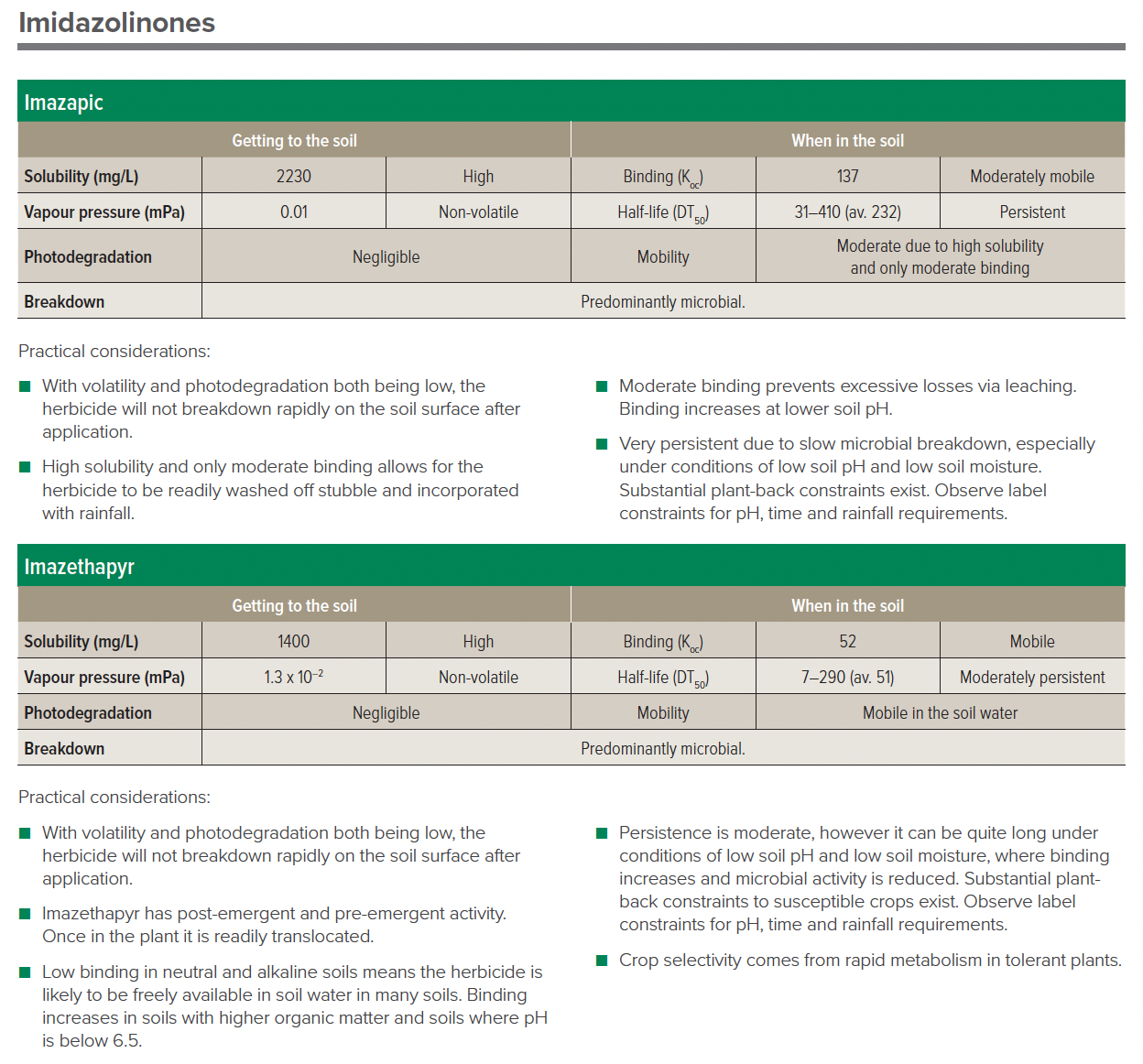
Extract from GRDC’s publication ‘Soil behaviour of pre-emergent herbicides in Australian farming systems’
Other resources:
- Clearfield stewardship brochure – BASF
- Soil behaviour of pre-emergent herbicides in Australian farming systems
- Understanding post-emergent herbicide use
- Pre-emergent herbicides 101 – free online course presented by Mark Congreve and Dr Chris Preston.
- Imi-tolerant crops – use sparingly and to best effect
