


It’s time for a Glyphosate Intervention

If you knew some folks were outside your house and planning a home invasion would you encourage them or do what you could to intervene?
Of course you wouldn’t invite them in or give them the weapons they needed to wreck your home and steal your stuff.
The problem is that weeds along roadways and fences are getting ready to invade crops all over the country, having been afforded the opportunity to train with the best herbicide available and now more and more of them have the weapon they need—glyphosate resistance.
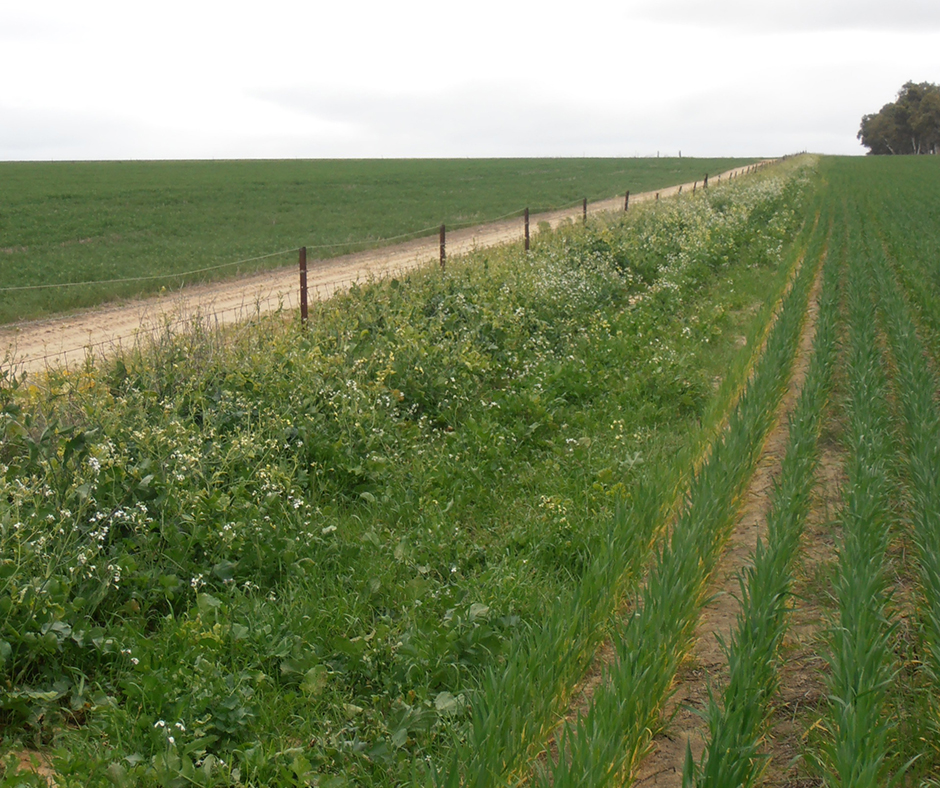
Weeds along roadways, fences and farm infrastructure are getting ready to invade crops all over the country, having been afforded the opportunity to train with the best herbicide available and now more and more of them have the weapon they need—glyphosate resistance.
At a meeting of concerned growers, agronomists and researchers at the Crop Updates in Perth earlier this year, discussion centred on the fact that the weeds growing on non-crop areas in and around farms are without doubt the main source of glyphosate resistant weed seed. There is also no doubt that these weeds are ready and able to move into crop areas, as soon as the opportunity arises.
The audience heard from Esperance grower, Chris Reichstein, who has brought glyphosate resistant ryegrass growing on a newly purchased property under control. Chris’ message was encouraging in that glyphosate resistance is manageable but it has placed a burden on his business that would have been avoided if better practices had been employed in the non-crop areas of the farm over the previous 15 or 20 years.
Chris has used every tactic possible to reduce weed seed numbers on the farm, including rotation planning to make the most of crop and herbicide combinations, including swathing and croptopping, narrow windrow burning, chaff carts, autumn tickle and a triple knock strategy of two chemical applications followed with a competitive crop. Containing the problem is now a permanent part of his farming system.
It is unrealistic to ‘ban’ the use of glyphosate along fences, roadways and around infrastructure, but it is clear that growers need to find other ways to manage these weeds without reaching for glyphosate as the first and only option.
There are other options, albeit more difficult, time consuming or expensive but imagine how difficult farming the cropping area would be without glyphosate. Depending on the situation, some fenceline tactics to prevent seed set could be to use different herbicides and change the timing of sprays to target weeds when they are small, planting the crop right to the fenceline and then cutting the first round for hay, using a ‘slash and spray’ approach, cultivation and knife rolling—anything but glyphosate!
Just last year a flood of evidence emerged, all pointing toward the imminent and widespread threat of glyphosate resistance:
- Sally Peltzer, DAFWA, released the results of a GRDC funded survey that sampled ryegrass from 175 paddocks, finding glyphosate resistance in 40% of them.
- John Moore, DAFWA, reported finding similar levels of glyphosate resistance when sampling trucks at CBH, Albany.
- Dr Michael Ashworth, AHRI, reported the first case of glyphosate resistance in wild radish.
- Adam Jalaludin, AHRI student, found a population of crowsfoot grass in Malaysia with resistance to glyphosate, glufosinate and paraquat.
- In NSW, glyphosate resistant sowthistle was confirmed and Queensland announced glyphosate resistance had been confirmed in sweet summer grass.
- Concerned agronomists raised the alarm as knockdown failures became evident in the field.
Now is the time for action and the implementation of a new system for managing weeds in the non-crop areas of Australian farms.