New seed technology requires broader herbicide resistance management in cotton

with David Thornby, data modeller, Innokas Intellectual Services
In 2013, the Cotton Research and Development Corporation (CRDC) introduced the ‘2 + 2 and zero survivors’ weed management program to extend the effective ‘life’ of over-the-top glyphosate in Roundup Ready (RR) cotton systems.
David Thornby, data modeller with Innokas Intellectual Services says growers broadly adopted the recommendation to use two non-glyphosate tactics in-crop and two non-glyphosate tactics in fallow and to eradicate any survivor weeds.
“The 2 +2 and zero recommendation was implemented to slow the development of glyphosate-resistance in cotton system weeds,” he says. “Over the last decade, cotton growers have broadened their herbicide programs, and the industry is also expecting a shift from RR Flex cotton varieties to the new XtendFlex varieties with triple-stacked herbicide tolerance technology.”
With these two factors in mind, the industry invested in the development of a new strategy, using the Diversity model to run hundreds of simulations of multi-herbicide strategies in mixed weed populations.
“Cotton growers are now contending with glyphosate-resistant weeds and shifting weed spectrums. This calls for a broader range of chemistries to manage the weed seed bank,” says David. “The new herbicide resistance management strategy (HRMS), funded by the CRDC, under a NSW DPIRD project, expands the diversity of weed management to apply six or more weed management tactics over two years, with a strong emphasis on the need to control survivor weeds.”
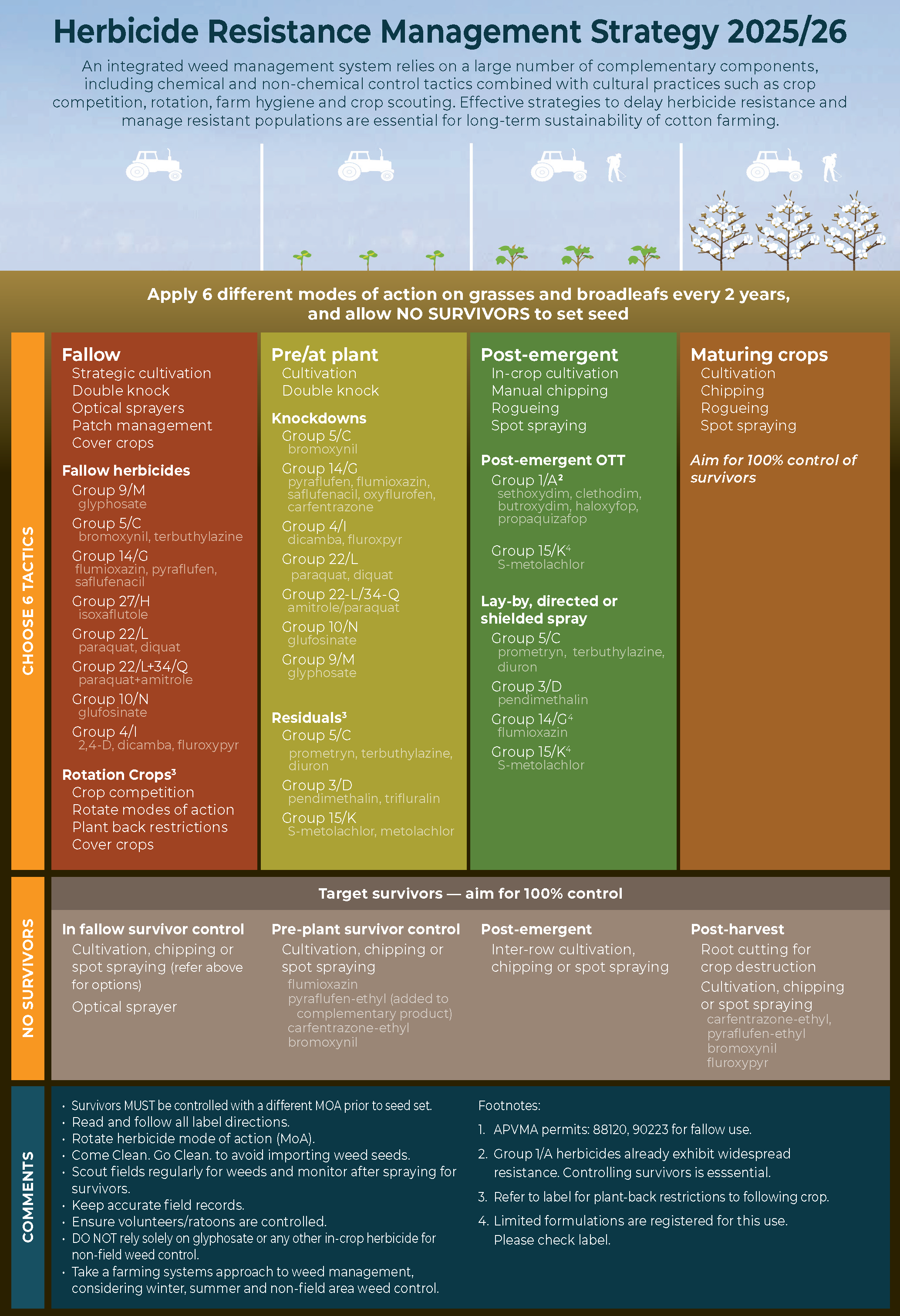
The herbicide resistance management strategy for cotton farming systems details the WeedSmart tactics growers can deploy in fallow, rotational crops and throughout the cotton cropping phase.
How does the cotton HRMS work in fallow and rotational crops?
The 2025/26 cotton HRMS suggests that growers apply at least six different weed control tactics to target grass and broadleaf weeds spanning a two-year period. More tactics may be required if the program includes grass or broadleaf selective herbicides. The program should include both herbicide and non-herbicide tactics where possible.
In the fallow period, consider strategic cultivation, double-knock, optical spot spraying, patch management and cover crops. Mix and rotate herbicide mode of action groups within the fallow herbicide options (Groups 9, 5, 14, 27, 22, 22+34, 10 and 4). Scout for and eliminate survivor weeds before they set seed using chipping, cultivation, manual spot-spraying or optical spot-spraying.
Rotation (and cover) crops are a powerful weed management tactic in cotton systems. In these crops, use the WeedSmart Big 6 program to minimise weed growth and drive down the weed seed bank. Set up rotational crops to be as competitive as possible, to provide paddock-wide weed suppression and other farming system benefits. When planning the herbicide program, focus on using alternate modes of action and effective application, and be aware of any plant-back restrictions, particularly for cotton. There are also opportunities for stopping seed set and even harvest weed seed control.
What does the HRMS recommend for the cotton crop phase?
The cotton phase relies heavily on herbicide weed control and associated seed technologies. The industry expects a shift from RR Flex technology to XtendFlex technology, enabling over-the-top applications of glyphosate, dicamba and glufosinate.
Irrigated systems with back-to-back cotton and only occasional breaks are at greatest risk of evolving herbicide-resistance in weeds. To protect the long-term efficacy of this new seed technology, devise a program that includes an array of other herbicide modes of action to minimise the risk of herbicide resistance.
When selecting knockdown, selective and residual herbicide products, aim to choose from different mode of action groups to those applied in the previous crop year. Overlap residual applications to provide good control until crop competition kicks in.
Cultivation and double-knock applications applied pre-plant and at planting provide a weed-free seedbed. The double-knock does not always have to involve two chemical applications, for example, cultivation plus a residual herbicide, or knockdown plus chipping, are also double-knock strategies to control survivor weeds. The transition from fallow or rotational crop to cotton is also an ideal time for optical spot-spraying at high rates on sparse weed populations.
When selecting knockdown and residual products, aim to choose from different mode of action groups to those already applied in the previous year.
In the post-emergent crop phase, inter-row cultivation, chipping and rogueing provide survivor control while post-emergent over the top (OTT) sprays and lay-by or shielded spray application of herbicides control new germinations.
Finally, in maturing crops, keep inter-row spaces weed-free with cultivation, chipping, rogueing and spot-spraying. Post-harvest cultivation for crop destruction is a valuable weed control tactic to eliminate survivors.
What are some example strategies that will minimise resistance risk in cotton crops and in fallow?
An excellent in-crop strategy that minimises resistance risk and provides high-level weed seed bank control in cotton is:
Double-knock with glyphosate/paraquat prior to planting, two different residual MOA applied at/near planting and layby, two or three OTT glyphosate applications, one OTT dicamba, one glyphosate/glufosinate double-knock, then use late-season tillage or spot-spraying for survivor control in the inter-rows. Avoid using 2,4-D in the previous fallow season.
In the fallow, a low resistance risk strategy is:
Two or three glyphosate applications applied in a double-knock and using an optical spot-sprayer at high rates where possible, two different residual MOA applied early and mid-fallow, one broadleaf herbicide application (try to avoid 2,4-D, clopyralid and fluroxypyr due to cross-resistance risk with dicamba) and consistent survivor control, including cultivation and other mechanical methods. Glufosinate is registered for high-rate applications through optical sprayers, though its efficacy on glufosinate-resistant plants is currently not well understood.
WeedSmart provides a practical planning framework and farming systems approach to integrated weed management to keep weed numbers low. The more diversity you can build into the farming system and the weed control program, the better. Diversity in cropping systems and in weed control keeps herbicides working for longer, protects seed technologies, builds soil health, maximises crop yield and improves long-term profitability.
More information
CRDC publication – Cotton Herbicide Resistance Management Strategy 2025-26
CRDC publication – Cotton integrated weed management