


Science backs Double-breaks to beat Annual ryegrass


‘Diverse crop and pasture rotation’ is one of the pillars of the WeedSmart Big 6, and for good reason. The farming system underpins all other weed management tactics, particularly for aggressive and adaptable weeds like annual ryegrass.
Identifying crop sequences that can remain profitable whilst reducing the weed seed bank gives growers the confidence to plan ahead to keep weed numbers low and to respond to unavoidable blow-outs.
In 2012, members of the FarmLink grower group in southern NSW were keen to know:
- How much grain yield am I losing if there is annual ryegrass in my wheat fields?
- Can annual ryegrass be managed more cost-effectively with break crops in a diverse crop sequence than in wheat crops?
- Is it possible to adequately control herbicide-resistant annual ryegrass in wheat crops with increased inputs and newer, more costly, herbicides with different modes of action to those used in the past?
To find out, CSIRO Agriculture & Food researchers Tony Swan, Laura Goward, James Hunt, John Kirkegaard, and Mark Peoples conducted two on-farm experiments near Eurongilly in southern NSW.
Practical tips:
- What does it take to break an annual ryegrass stranglehold?
Three years of complete weed seed control (over 95%) followed by high-level control in subsequent years to keep the weed seedbank low. - What’s the best 3-year sequence for annual ryegrass control?
A double-break followed by high-level weed management in the following wheat crop. An effective double-break is consecutive broadleaf crops (e.g. legume plus canola) or a broadleaf crop followed by cereal hay. - What does it take to lose the hard-earned gains?
Just one year of less effective weed control. In some seasons, it is difficult to achieve timely and effective weed control. Immediately implementing a double-break recovery strategy will reduce the impact of a weed seedbank blow-out.
A double-break, consisting of two consecutive broadleaf crops, is a strategic tactic to deploy within the WeedSmart Big 6 integrated weed management program to drive down the weed seedbank throughout the crop sequence. This tactic increases the diversity of the crop sequence, boosts crop competition, stops weed seed set and provides additional opportunities to mix-and-rotate herbicide modes of action.
Experimental design features
Two 3-year on-farm studies in southern New South Wales compared the effect of:
- numerous 3-year crop-sequence options (continuous wheat v single-break v double-break), including winter fallow options, and
- two levels of weed control in the wheat and canola crops (conservative or aggressive),
on existing in-crop annual ryegrass infestations and soil seedbanks.
Gross margins were calculated for each combination of treatments to compare the economic performance of each system over time.
The single and double-break sequences were tested against continuous wheat (W–W–W). The break crops included in the experiments were canola and lupin grain crops, cereal hay and brown manure field pea. The cereal hay was cut, and the field peas terminated before the annual ryegrass seed set. The winter fallow replaced a winter crop with a bare soil fallow that was kept weed-free for 18 months.
The single-breaks were mostly implemented to replace wheat in Year 1, i.e. break crop–wheat–wheat, or fallow–wheat–wheat sequences. The only Year 2 single-break option evaluated was a canola grain crop (i.e. wheat–canola–wheat).
Double-break sequences were implemented in Years 1 and 2. The double-break crops tested in the experiments were legume–canola–wheat, fallow–canola–wheat, and canola–cereal hay–wheat.
Two levels of weed management were applied as follows:
- Conservative, lower-input weed management, representative of local farmer practice, applied to Year 1 and/or Year 2 wheat grain crops and Year 1 canola.
- Aggressive, higher-cost and higher-input weed management regime using higher plant densities and nutrient supply, and, in the case of canola, a vigorous hybrid, and newer, higher-cost pre-and/or post-emergent herbicides with modes of action expected to improve the prospects of killing annual ryegrass populations that had developed resistance to widely-used herbicides.
The first experiment on (Farm 1) started in autumn 2012 and ran until harvest 2014. The second experiment (Farm 2) began in autumn 2013 and ran until harvest 2015.
The initial annual ryegrass seedbank of viable seeds measured prior to the trial commencement on Farm 1 was 1815 seeds/m2. On Farm 2, the initial count of viable seeds was 2775 seeds/m2.
A ‘quick test’ on live annual ryegrass plants from both sites showed that the endemic population was resistant to haloxyfop, clethodim and pinoxaden (Group 1) herbicides and iodosulfuron-methylsodium, imazamox and imazapyr (Group 2) herbicides to varying degrees (30–95%). The population was susceptible to glyphosate (Group 9), atrazine (Group 5) and butroxydim (Group 1) herbicides.
Testing for resistance to pre-emergence herbicides was not conducted at the sites. However, random surveys conducted in the region in 2014 found no resistance to pre-emergent herbicides registered for annual ryegrass control.
Detailed findings
These experiments answered the FarmLink grower group’s questions and more.
How much grain yield am I losing if there is annual ryegrass in my wheat fields?
Competition from annual ryegrass reduced wheat grain yield by 0.45 t/ha for every additional 1.0 t/ha of in-crop annual ryegrass dry matter measured in late spring.
On average across both experiments and six years, 1 t/ha ARG dry matter in spring produced 235 spikes/m2. Since it is easier to count ARG spikes per m2 than measure weed biomass, growers and agronomists can estimate grain yield penalty by counting ARG spikes.
Can annual ryegrass be managed more cost-effectively with break crops in a diverse crop sequence than in wheat crops?
Annual ryegrass assessments taken in late-spring of Year 3 showed:
- The most effective single-break systems were fallow, brown manure field pea, lupin or canola(aggressive) when followed by two years of wheat(aggressive) (118–162 seed/m2), which represented a 95–96% reduction in the annual ryegrass seedbanks compared with wheat(conservative)–wheat(conservative). However, these single-break treatments were either totally ineffective (causing an increase in the seedbank), or provided <70% reduction in annual ryegrass seedbank counts if they were followed by a single year of wheat(conservative).
- The most effective double-break sequences resulted in a 96–98% reduction in the annual ryegrass seedbank. The most effective sequences were brown manure field pea, lupin, fallow or canola(aggressive) in Year 1, followed by canola(aggressive) or cereal hay in Year 2 (Farm 1: 3–15 spikes/m2, 0.01–0.07 t DM/ha. Farm 2: 4–29 spikes/m2, 0.04–0.13 t DM/ha). High-input (aggressive) wheat crops were also effective at reducing the weed seedbank.
The systems with the highest cumulative profit over the full three years of the study at both sites included canola–cereal hay double-break in Years 1 and 2 and single-break systems that had either canola or lupin grain crops in Year 1.
The systems with the lowest cumulative profits were continuous wheat and those with fallow, brown manure field pea or conservatively-managed wheat in Year 1.
The canola(aggressive)–wheat(aggressive) sequence was also among the least profitable systems because of the low yield and profit in Year 1, and the impact of frost damage in Year 2, highlighting the risks associated with the investment in high-input systems.
Is it possible to adequately control herbicide-resistant annual ryegrass in wheat crops with increased inputs and newer, more costly, herbicides with different modes of action to those used in the past?
The highest annual ryegrass infestations (943 spikes/m2, 1.58 t DM/ha with a final ARG seed bank population of 3140 seeds/m2 in year 4) were recorded in the wheat(conservative)– wheat(conservative)– wheat(aggressive) sequence on Farm 1. This level of infestation is expected to result in 3.5 t loss in wheat grain yield. This was also observed on Farm 2, although the infestation following conservatively managed wheat was much lower than on Farm 1 (167 spikes/m2, 0.28–0.48 t DM/ha with a final ARG seed bank population of 1693 seeds/m2 in year 4), resulting in less impact on wheat yield.
However, the residual ARG seed population at both farms remained very high and would require a further three years of complete ARG seed control (zero weed seed set) to bring this weed seed bank down to a manageable level.
Aggressive (high-input) management of wheat reduced the annual ryegrass seedbank, but only marginally.
Summing up
Some rules of thumb for maximising the benefit of break-cropping:
- Least effective option – Continuous wheat crop sequence is the least effective way to reduce annual ryegrass infestation. When aggressive management was applied in the third wheat crop, there was only a 39 per cent reduction in the weed seedbank.
- Minimal impact option – Single-breaks provide effective control of annual ryegrass for that season, but the benefit is lost if conservative management is applied in subsequent wheat crops.
- Highly effective option – Double-breaks of fallow or brown manure field pea followed by canola(aggressive); or canola(aggressive) followed by cereal hay can reduce the annual ryegrass seedbank by 95 to 99 per cent, and were frequently the most profitable sequence.
- There are many low-risk opportunities to increase management inputs. Investigate and implement ways to increase crop competition, introduce newer herbicides strategically, prevent in-crop weed seed set and use harvest weed seed control to manage late germinating weed escapes.
The research work was supported by a grant (project CSP000146) from Grains Research Development Corporation, a WeedSmart platinum sponsor.
- Swan AD et al. Diverse systems and strategies to cost-effectively manage herbicide-resistant annual ryegrass (Lolium rigidum) in no-till wheat (Triticum aestivum)-based cropping sequences in south-eastern Australia, (2023) Crop & Pasture Science, 74(9), 809–827. https://doi.org/10.1071/CP22370
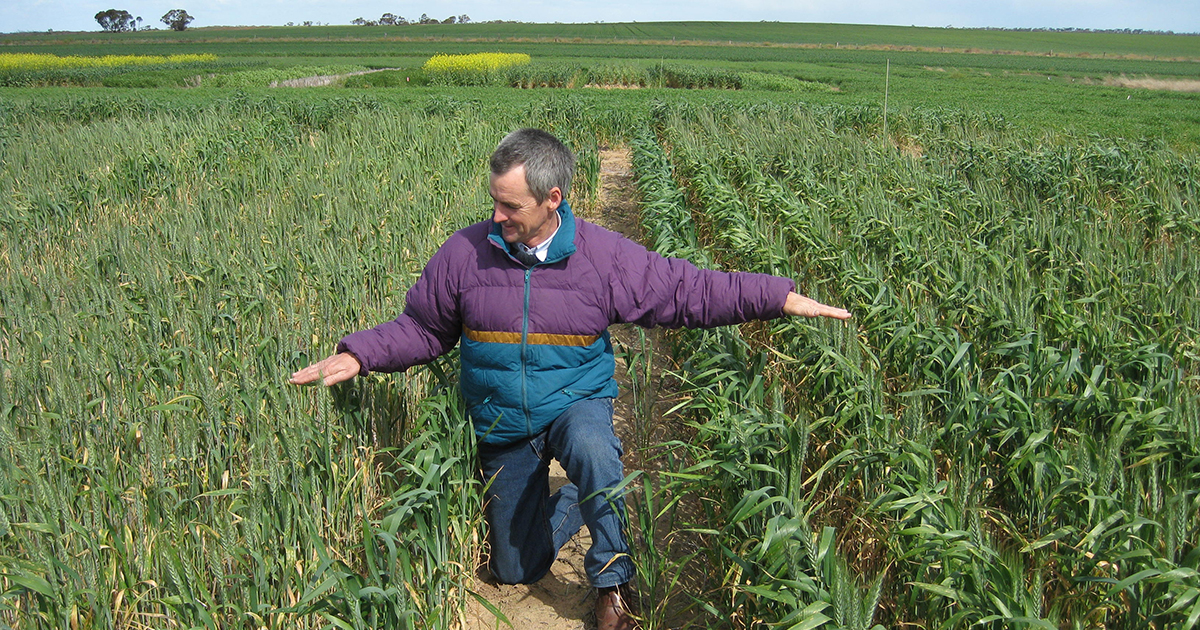
Wheat after a double-break (right) and following wheat (left). Photo: CSIRO
