Mothvine and automated spraying in the spotlight on WeedSmart irrigated agriculture tour

If there’s one thing we know about the agriculture industry, it’s that everyone loves having a look at other people’s farms. WeedSmart Week always aims to satisfy that thirst, and those who joined the irrigated study tour on day 3 were treated to an inside peek at two of Griffith’s most unique set-ups: Go.Farm’s commercial almond orchard and DPIRD NSW’s grape and citrus research farm.
Facilitated by WeedSmart’s Northern Extension Agronomist, Paul McIntosh, the study tour theme was ‘Innovation in Irrigated Weed Management.’
Addressing the crowd at Go.Farm’s Nericon site, Peter Reynolds, Industry Development Officer at Almond Board Australia, said that herbicide options registered for use in almond crops are extremely limited, so targeting weeds young and small is key.
Go.Farm’s General Manager – Riverina, Luca Rivadossi, also noted that the window for spraying in almond orchards is very narrow, and often occurs at night, so finding labour for the farm can be challenging.
To help capitalise on such narrow spraying windows, Go.Farm invested in an OMC AR-500 automated tractor with Bonsai Intelligence.

Go.Farm’s autonomous sprayer in action!
The crowd enjoyed a demo of the driverless sprayer, which moved effortlessly through the orchard rows, and stopped abruptly when a few brave attendees tested out its safety braking mechanism by standing in front of the moving machine.
Spray efficacy was also a hot topic of the day, with Croplands’ David Hamilton and Jeremy Rennick showcasing the differences in coarseness between nozzles on their Weed-It demonstration spray rig. The group also enjoyed a live demo of the newest Nelson Hardie orchard sprayer, which lived up to its’ ‘air-blast’ name!
Moving on to the second tour stop at the Griffith Centre for Irrigated Agriculture, attendees were faced with something much scarier than automated technology: mothvine.
Mothvine is a fast-growing weed causing big headaches for eastern states growers. Its vines rapidly climb larger plants, smothering citrus trees and grape vines. Its sap is also known to cause skin and eye irritation, and the leaves and seeds are poisonous to people and livestock.
Site Manager Joe Valenzisi showed the tour group a few horrifying mothvine specimens sprawled over their trellised grape vines. Once the weed matures, he says, it is near on impossible to kill.
Mothvine spreads via multiple mechanisms with fruit containing up to 400 seeds per pod, which split while still on the vine and spread through the wind, water, and by attaching to clothing and animals.
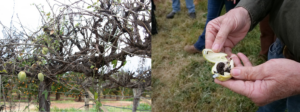
Left: A mothvine plant covering a trellised grape vine. Right: A split mothvine pod containing up to 400 seeds.
The seeds can remain viable for up to five years, and the ease with which they cling to clothing and vehicles makes farm hygiene critical, says Joe.
Mothvine is also a big problem in the region’s citrus industry. Elders Horticultural Agronomist, Emily May, urged the crowd to consider skirting their citrus trees if not already doing so.
Skirt pruning raises the tree’s canopy higher off the ground, so emerging mothvine plants can be more easily spotted and pulled out before they smother a tree. According to Emily, sacrificing a small amount of produce is worth it in the long run to prevent the spread of mothvine.
Similar to the almond industry, as smaller sectors, there is limited chemistry available for use in Australia’s citrus orchards and vineyards. This has led to much experimentation for dealing with mothvine. Site manager Joe mentioned an earlier trial of strategic burning, which he said backfired and caused higher rates of germination.
Both Emily and Joe reiterated that physical removal of the vines while specimens are small is still the best management technique. However, for long-term control, nothing beats being a good neighbour.
In Griffith, abandoned orchards with mothvine infestations are causing significant problems for neighbouring farms, as seeds spread easily across paddocks. While area wide weed management may be a utopian ideal, there’s still much that can be done on your own fencelines and irrigation channels to help stop the spread of weeds into your own crops and your neighbours’.
Acknowledgements
This event was delivered by WeedSmart with regional support from the Irrigation Research and Extension Committee (IREC) and the NSW Department of Primary Industries and Regional Development (DPIRD).
WeedSmart is grateful to Iva Quarisa, IREC, farm hosts Luca Rivadossi and Joe Valenzisi, and the team at Go.Farm for putting on a beautiful morning tea. Many thanks also to our local irrigated agriculture steering committee and our wonderful speakers for all their assistance in putting together this event.
Regional Event Partner