


WeedSmart’s health and safety check-up

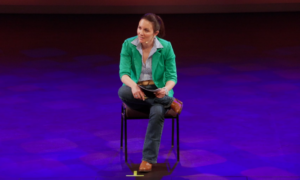
Alex Thomas addresses the crowd at WeedSmart Week 2026 in Griffith
Armed with a violin, thumping soundtrack and her signature enthusiasm, Alex Thomas urged the 2026 WeedSmart Week crowd in Griffith to look beyond health and safety compliance and focus on ‘keeping people alive and well’ on farms.
Alex grew up on a remote sheep station in South Australia and has been working in the health and safety industry for over 20 years, specialising in the issues faced by regional communities. Her lived experience advocating for her dad, Chris, as he navigated the complications of Q Fever and the stresses of living and working on the land, galvanised her to shine a spotlight on the need for everyone to take back their authority for their own health and safety, and to listen to their body when something doesn’t feel right.
Alex says, “It can be useful to get advice from a safety professional, app company, doctor, allied health professional or third-party ‘expert’; but sometimes our deferral to that authority and their expertise unintentionally distracts or de-rails us from what we – as the experts in our own farming operations and bodies – know to be true.”
“Health and safety expertise is really important, but it’s only helpful when coupled with context… and it’s up to us to take our authority back and make sure our context is heard,” said Alex.
Alex’s presentation touched on some pervasive issues; according to FarmSafe Australia’s ‘2026 Safer Farms Report’, one life is lost on Australian farms every six days, with grain and livestock farms accounting for almost half of all incidents in the agriculture sector.
As part of taking back authority for our own health and safety, Alex invites each person to ask: “Who or what am I delegating my authority for my health or safety to? Why, and what happens when I do?”
For most people in the crowd, the reality of rural healthcare and the safety challenges of farm work are all too real, yet many struggle to advocate for their health and wellbeing. Alex’s invitation to listen closely to the signals from our bodies resonated and was a key takeaway message from the day.
It’s a familiar theme echoed in the latest FarmSafe Australia report, which encourages all workers to challenge ‘she’ll be right’ culture in favour of slowing down and getting the job done safely.
FarmSafe’s 2026 motto is ‘Set the standard. Show ‘em how it’s done.’ As a farm employer or employee, that means prioritising safety every day and setting a good example for others to follow.
Alex says this does not mean every task needs to become a box-ticking exercise, but rather an opportunity to stop and ask, what could go wrong and what do we need to do to prevent that from happening?
Day-to-day weed management tasks also pose their own unique risks. For farmers handling herbicides and other chemicals, it’s important to consider which safety measures actually have the most impact. Safety controls which eliminate or modify hazards are much more impactful than administrative controls. And in order to really make a difference, safe chemical handling practices must be implemented every day. This includes using closed mixing systems, enclosed tractor cabs with filters, personal protective equipment, correct storage and transportation of products, not pushing through fatigue, and pausing to reassess if a task feels unsafe or could be done better.
For farms with children on site, modelling safe behaviours is especially important. There were five child fatalities on Australian farms last year, with work involving tractors, quad bikes and side-by-side vehicles again the leading cause of deaths. Small, simple changes (such as fitting rollover bars on quad bikes) and demonstrating good habits (wearing a helmet) can help kids learn how to be safe on farm. For working with tractors, FarmSafe Australia has many tips for reducing the risks associated with hydraulics, split rim tyres, PTOs, rollovers and noise.
FarmSafe Australia Chair, Felicity Richards, says that most incidents don’t happen because people don’t care about safety. They happen during routine jobs, busy periods and moments of pressure when shortcuts begin to creep in.
To avoid preventable accidents, FarmSafe recommends farm owners and managers establish mutual trust with employees by having honest conversations and asking staff about their safety concerns. These do not have to be formal conversations – some of the best safety chats happen at smoko.
A major part of being safe on the job also stems from looking after your health and wellbeing outside of work. Do your best to make time off the farm for friends, family and fun!
WeedSmart is proud to support the Fat Farmers rural health initiative, which aims to create mentally and physically healthy farming communities through social exercise groups. There are 77 Fat Farmers groups scattered across Australia – check their website for a group near you or start a new group: www.fatfarmers.com
Resources:
- FarmSafe Australia – Safer Farms Report 2026
- Find a Fat Farmers Group
- Find an Active Farmers Group
- FarmSafe Australia Toolbox Talks
- Lifeline (mental health support via phone): 13 11 14
- Health Direct (medical advice via phone): 1800 022 222
- Beyond Blue (mental health support): 1300 22 4636
- Men’s Line (men’s mental health support): 1300 78 99 78

Alex uses music to help the audience ‘feel’ into their body