Stop Johnson grass before it is a perennial problem

Johnson grass, like other perennial weeds, has multiple survival strategies that can make its management a long-term project.
Lynda Kebaso, a PhD candidate at the University of Queensland, working with Dr Gulshan Mahajan, Dr Dane Panetta and Professor Bhagirath Chauhan, is investigating the ecology of Johnson grass to underpin an integrated weed management strategy for this invasive weed.
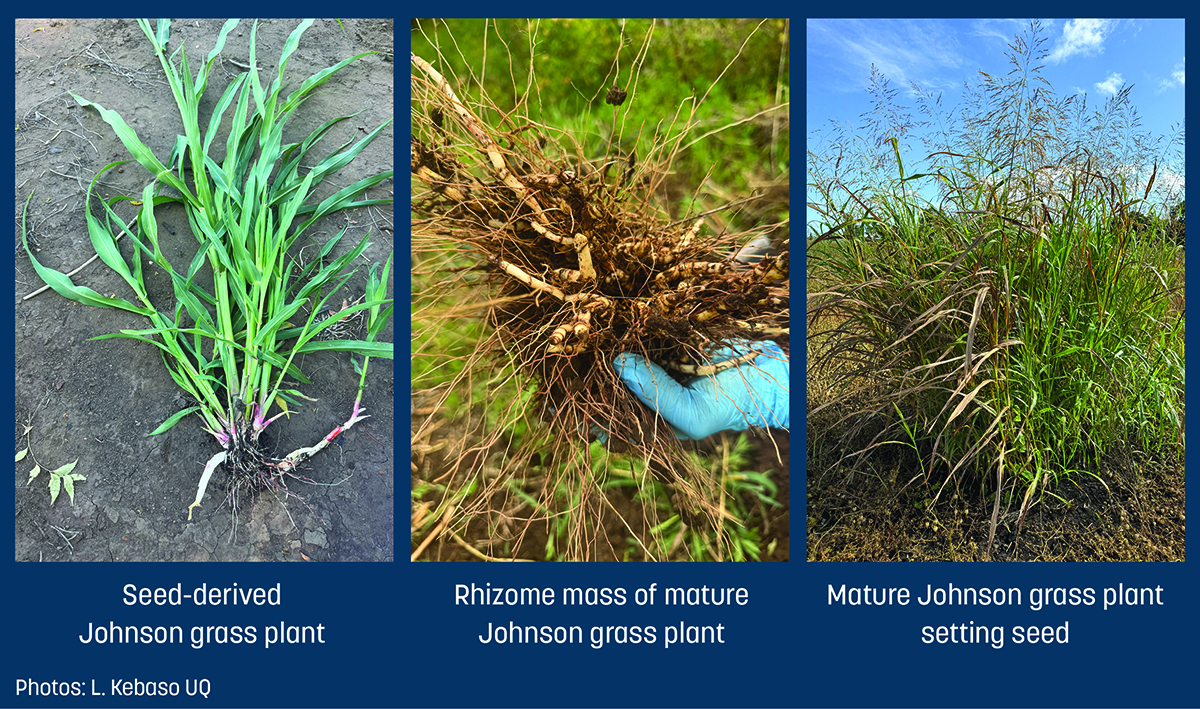
“Infestations of Johnson grass are particularly difficult to manage in sorghum crops,” says Lynda. “Johnson grass plants are best controlled when they first establish from seed. Once the plants have matured, their rhizomes provide a robust mechanism for regrowth after control tactics are implemented.”
Mature plants grown in a pot trial produced 6200 seeds per plant. Under favourable field conditions, Johnson grass grows up to 2 m tall and can produce up to 60,000 seeds per plant. Seeds can remain dormant on the soil surface and emerge in staggered flushes.
The main germination events occur in spring and early summer. Leaf growth on new seedlings is rapid for the first few weeks, and the first flowering occurs just seven weeks after germination. After the first flowering, rhizome production accelerates. The plants are dormant over winter, then shoots emerge from the rhizomes as soil temperatures rise in spring. A single plant can produce over 60 m of rhizomes, giving rise to multiple ‘new’ plants that are primed to rapidly set seed. These plants produce their own secondary and tertiary rhizomes, and the original primary rhizomes die each autumn.
The mass of creeping white rhizomes (underground stems) is a key identification feature that distinguishes Johnson grass from similar Sorghum species such as Columbus grass (a short-lived perennial with short rhizomes) and shattercane (an annual grass with no rhizomes).
Johnson grass is present in cropping regions of Queensland, New South Wales and Western Australia, where it can significantly impact summer crop yield and host crop pests and diseases.
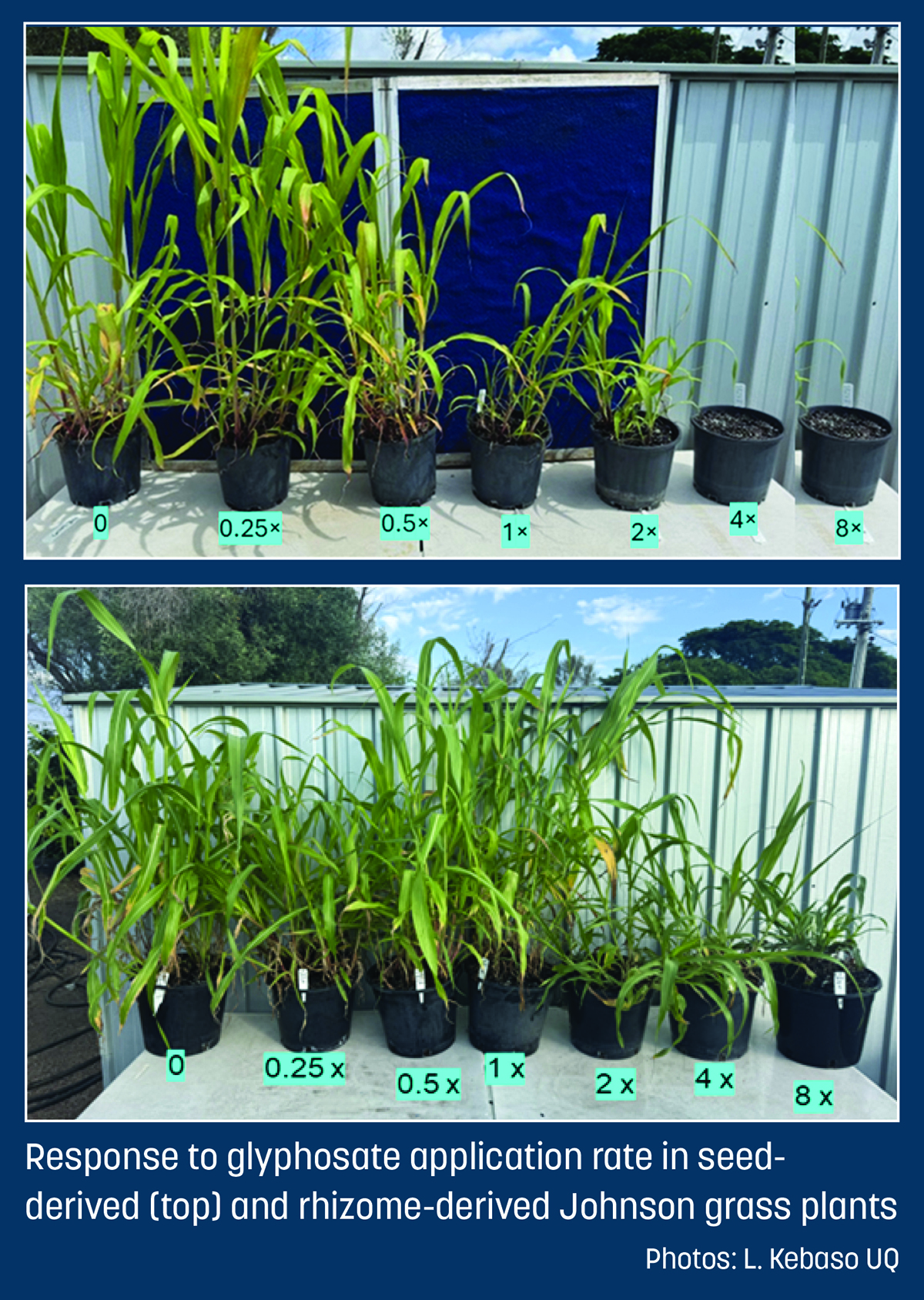
“Clearly it is very beneficial if seedlings are controlled before they set seed and before they produce rhizomes,” says Lynda. “Professor Chauhan confirmed the first Australian case of glyphosate resistance in Johnson grass in 2019. Our research showed glyphosate resistance in some seed-derived plants, but plants that had regenerated from rhizomes were difficult to control with glyphosate. This explains the expansion of this weed in no-till farming systems with a history of glyphosate use.”
Lynda says screening of four populations of Johnson grass showed that haloxyfop, clethodim, clodinafop and imazamox + imazapyr provided complete control of seed-derived plants. In contrast, responses to glyphosate varied considerably among populations, while glufosinate, butroxydim, atrazine and imazapic did not provide complete control under the conditions of the experiment.
“The main germination cohort of seeds present in the top 1–4 cm of the soil profile occurs under warm post-rain conditions in spring and early summer,” says Lynda. “Effective post-emergent herbicide treatments of newly-emerged seedlings prior to planting a competitive crop plus the added protection of an effective pre-emergent herbicide, such as s-metolachlor, is a robust control tactic. Maintaining high surface mulch also modifies the soil temperature and light exposure, suppressing germination.”
If plants have established and produced rhizomes, any tactic that reduces leaf growth will also reduce rhizome development. Heavy grazing, repeated mowing, crop competition and multi-pass cultivation can help reduce the accumulation of underground reserves in patches where mature Johnson grass has established. Persistent defoliation can eventually starve mature plants and prevent regeneration.
While it has a place in an integrated management program, cultivation must be well-planned and managed to reduce the risk of spreading rhizomes to other areas. Lynda’s research showed that Johnson grass emergence from seed buried 8 cm or deeper was very low. However, this buried seed can remain viable for several years. Subsequent cultivation could return these seeds to the upper 4 cm of the soil profile and trigger a fresh infestation.
Peter and Kylie Bach, farming at Pittsworth on the Darling Downs used a chaff deck on their header to target a large population of Johnson grass on a farm they bought in 2016.
In the first five years of using this harvest weed seed control tool in all their crops, Peter saw a massive reduction in the extent of previously large populations of Johnson grass on the farm.
“The chaff deck applied consistent downward pressure on the Johnson grass seed bank every year and also helped us manage feathertop Rhodes grass,” says Peter. “Of course, the benefit is most noticeable when populations start high, but it is also good to know that it is also effective in keeping numbers low across the farm.”
“When we do fallow sprays, we run larger nozzles over the wheeltracks to make sure any weeds that germinate are controlled before they can set seed,” he says. “In some instances, the only weeds present in-crop are along the wheeltracks so we can just turn on the six nozzles running over the three sets of wheeltracks.”
In the recent wetter years, Peter has seen the Johnson grass numbers increase again. He says their crop rotation of imi-tolerant grain sorghum – utilising Intervix (imazamox + imazapyr), mungbeans and barley is providing adequate suppression of Johnson grass. He expects to be able to run down the seed bank during drier years.
The combination of weed seed destruction at harvest and a disciplined approach to stopping Johnson grass plants from developing rhizomes within the Bach’s WeedSmart Big 6 integrated weed management program is the long-term solution.
More resources
- Kebaso LK, Mahajan G, Panetta FD, Chauhan BS (2026). Seed dormancy and germination ecology of Johnsongrass (Sorghum halepense) in eastern Australia. Weed Sci. 74(e31), 1–10. doi: 10.1017/wsc.2026.10099
- Peter and Kylie Bach case study and video
- Weeds Australia Johnson grass identification guide