


Regulating automation in crop protection application
Australian broadacre and horticultural farmers are currently leading the global demand for precision crop protection application technologies.
Technologies that detect the presence of a weed, pest or disease and apply the relevant crop protection product directly to the target.
Dr Rohan Rainbow, Crop Protection Australia director says the productivity gains are driving demand for precision targeted application technologies in Australia.
“Hitting the pest and not the crop has layered benefits,” he says. “Less product is wasted on areas with no pest present, less pesticides in the environment and less potential for off-target drift. And that’s just from the input side. Add to this the reduced crop damage and potential crop yield increase, reduced pesticide residue risks, and significant time and labour savings.”
Rohan says there are now more than ten green-on-brown optical spot-sprayer technology (OSST) manufacturers and more than seven green-on-green OSST manufacturers. In Australia, there are another four manufacturers offering high-precision OSST technology that targets the weed but not the crop, reducing crop phytotoxicity and herbicide residue risk, mainly in the horticultural sector. Reducing crop phytotoxicity through targeted application can also potentially deliver significant improvement in average yield.
Rohan says fixed-wing aircraft fitted with pulse width modulation sprayer capability, supported by prescription mapping can also undertake variable rate applications of fungicide, cotton defoliant and even herbicide application to mapped patches of weeds.
The first of these technologies were sensors that detect the chlorophyll flourescence in plants (typically weeds) growing against a background of stubble or bare earth. The green-on-brown weed detection and spot-spraying concept was invented in the mid-1980s, by former NSW DPI researcher Warwick Felton, who showed how growers could save up to 80 per cent of their fallow herbicide costs.
His licenced IP underpinned the product development work of Jim Beck, Patchen Systems, delivering WeedSeeker technology to the market. WeedSeeker was eventually acquired by Trimble.
Green-on-brown weed detection and spot-spraying has been widely adopted in Australia’s broadacre cropping farming systems since the first WeedSeeker sprayer was imported into northern NSW in 2002, and Rometron’s WEED-IT soon followed.
In response to grower adoption, particularly in Queensland and northern NSW, the number of products registered for green-on-brown optical spot-spraying steadily increased from the original four (2,4-D, paraquat, glufosinate and glyphosate), to another 15 products under an industry-led minor use permit due to expire at the end of 2026 and full label registration of nine key herbicides from Nufarm.
In recent years, advances in technology have blown open the door to seemingly endless possibilities and new use patterns, fueling research and commercial developments, particularly in crop protection applications within the crop phase. A prime example is ‘green-on-green’ detection and spot-spraying of weeds in-crop.
In June 2024, Rohan estimated that there were around 800 autonomous machines used regularly in agricultural applications globally, with over 100 autonomous machines operating in Australia. By the end of 2024, he believed those numbers had at least doubled. Based on discussions with industry and commercial manufacturers, he believes that broadacre adoption of autonomous farm equipment by area will reach 85 per cent by 2032. While pesticide application using sensor-based sprayer technology, especially for weed control, is currently the majority of broadacre autonomy adoption, in the longer term, it is expected to represent at least 60 per cent of total agricultural autonomy adoption.
Rohan says the pace of advancement is a significant challenge in the regulatory space in Australia and globally. He foresees a regulatory requirement that growers will require data-based information or a prescription map prepared prior to use of green-on-green spot-spraying technology.
“Spot-spraying technologies, particularly for future use of green-on-green may involve herbicide products and application rates that may not be appropriate for blanket spraying,” he says. “For fallow spot-spraying, the current permit (soon to expire) and current registered labels include caps on the percentage of a paddock that can be legally treated with the specific product and spot-spraying rate. I expect similar caps may be required for green-on-green applications of crop protection products, especially herbicides approved for that use pattern, noting that the concentration of application in a paddock affects this risk.”
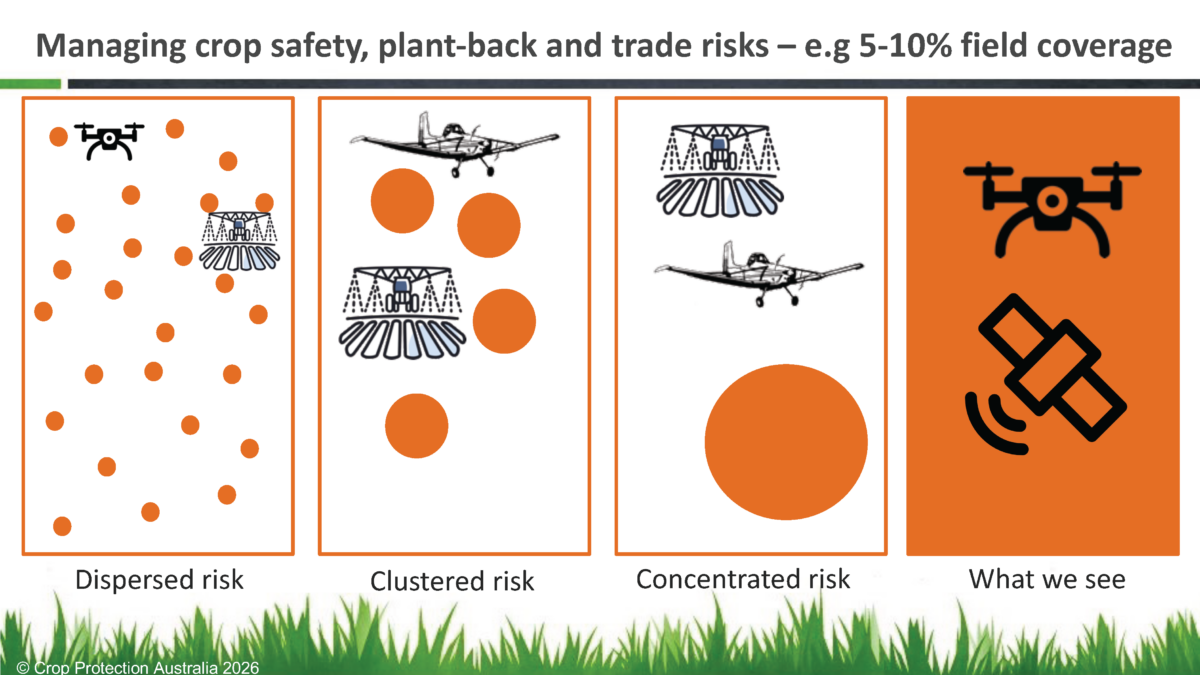
It is much easier to manage crop safety, plant-back and trade risks in fallow situations, where it is more obvious whether the target area represents a dispersed, clustered or concentrated risk, even if the percentage cover is the same.
“If the weeds are scattered across the field, there is less risk involved in targeted spraying systems on a ground rig or drone,” says Rohan. “For a clustered risk, a ground rig or possibly a fixed-wing and rotary-wing aircraft with variable rate application technology would be suitable options. Similarly, for a concentrated risk, except now the location of that risk is important.”
If the concentrated risk is near a border, spraying product at a higher product rate may raise concerns about downwind deposition (spray drift) and contravening buffer zone requirements.
“All this is far more complex in a green-on-green situation where it is more difficult to identify the spatial distribution of the spray targets before entering the field. Knowing how much product to mix in the spray tank prior to entering the field will minimise waste and is good business and environmentally responsible practice.”
“Capping the percentage area treated on labels for green-on-green applications could support risk assessment assumptions and enforcement activities around maximum residue limits,” says Rohan. “Potentially in the future, provided that digital labels were interacting with the digital platform controlling the spray operation, a warning could signal that a limit is approaching, and the system could stop spraying or revert to the lower blanket application rate when the limit is reached.”
This is where prescription mapping prior to green-on-green spraying is likely to be required. Rohan says satellite weed and crop density sensing tools, such as those being developed by Tim Neale at DataFarming, or drone mapping, provide the required information to plan in-crop spot-spraying jobs.
“The other essential component is digital labelling that enables the spray machine to read the label and respond with the appropriate rate according to the risk profile,” he says. “The combination of prescription maps and digital labels will minimise the spray risks and better calculate the amount of product required to complete the operation.”
In the shorter term, percentage-area-treated restrictions may not be enforceable without prescription maps, so Rohan says it may be beneficial to construct an industry-based stewardship framework to support this transition period.
He says that the appetite for this technology and the size of the market in Australia were major drawcards for the EPAC 2026 conference in Melbourne in February, 2026.
Hosted by the APVMA, the EPAC – ‘Advancing Sustainability in Agriculture: Enabling Precision Application of Crop Protection Products by Inclusion in Regulatory Approaches (Processes)’ conference was sponsored by the Organisation for Economic Co-operation and Development (OECD) Cooperative Research Programme. The resulting recommendations to the OECD are expected to influence global regulatory change for the precision application of crop protection products in coming years.
Key initiatives in the regulation of this technology to support adoption and to realise the full potential of its benefits include:
- OECD Drone/Uncrewed Aerial Spray Systems (UASS) Sub-Group (ODSG),
- OECD Digital Label Community of Practice,
- European Precision Application Task Force (EUPAF) and
- American Society of Agricultural and Biological Engineers (ASABE) and International Organization for Standardization (ISO) equipment standards.
The EPAC 2026 Technical Committee recommended the creation of an OECD Working Party on Pesticides Expert Group to 1. document a tiered approach to risk assessment as it applies to implementation, performance range, exposure-reduction potential and applications of various precision agriculture categories, 2. develop best management practice guides and training materials, and 3. link digital labels with compliance support solutions.
“In Australia, the SPAA, TMA and GPA consortium* are well-placed to contribute to these outcomes to ensure the regulations support safe and efficacious use of the available and future opportunities for precision crop protection use patterns on Australian farms,” he says. “This consortium has already delivered the 2021 Code of Practice for Agricultural Mobile Field Machinery with Autonomous Functions in Australia, for ground-operating machinery.”
*SPAA (Society of Precision Agriculture, Australia), TMA (Tractor and Machinery Association) and GPA (Grain Producers Association).
Autonomous platforms are being increasingly adopted in broadacre and horticultural settings across Australia. Rohan says the horticultural industries are overtaking broadacre in terms of complexity and sophistication of technologies, with dramatic benefits.
The Aerial Application Association Australia (AAAA) are currently updating the national stewardship and accreditation program’s Spraysafe manual to include education and accreditation for remotely piloted aircraft systems (RPAS), also commonly known as unmanned aerial vehicles (UAVs) or drones, in addition to the existing competencies for fixed and rotary-wing aircraft, for delivering targeted crop protection sprays. AAAA CEO, Matthew Harper, says the Spraysafe training and accreditation is university-level competency, reflecting a commitment to the safe and accurate handling and application of crop protection products.
The inclusion of RPAS into Spraysafe is key to having a single nationally recognised accreditation program for all aerial applicators, regardless of the technology used. Nationally consistent standards are the lifeblood of maintaining the social license for the application of crop protection products, and the AAAA is committed to ensuring that Spraysafe continues to set the standards, Matthew said.
More information:
EPAC 2026 presentations and outcomes: https://www.epac2026.org/outcomes
Code of Practice for Agricultural Mobile Field Machinery with Autonomous Functions in Australia:https://www.spaa.com.au/resources-spaa/autonomous-vehicles-code-of-practice/
Spraysafe: https://aaaa.org.au/programs/spraysafe/
Automation uptake and attitudes
In late 2025, Grain Producers Australia (GPA) conducted their second independent survey of grain producers’ attitudes toward and adoption of autonomous farm machinery.
The resulting ‘Grain Producers Australia Autonomous Farm Machinery Survey Report 2026’ summarises the responses from 220 growers to 19 core questions about their current use patterns, understanding and attitudes towards autonomous farm machinery in Australia. When these responses are compared to the survey data collected in late 2024, it is clear that grain producers in Australia are actively using, exploring and planning to adopt autonomous farm machinery within the short term.
The report states that ‘there is a key shift in adoption, rising from 27 per cent [in late 2024] to 45 per cent [in late 2025] of producers using autonomous or semi-autonomous systems. However, much of this growth remains in semi-autonomous technologies, with availability in Australia lagging globally.’
Within the survey group, adoption rates were highest in Western Australia, Tasmania and South Australia, and the most prevalent users (50 per cent) farmed properties of between 1000 and 3000 ha.
The survey responses also revealed ‘ongoing confusion between technologies or practices defined as precision agriculture and those considered autonomous’.
A consistent set of constraints to adoption in Australia, including cost (initial affordability and set-up costs), proven return on investment, connectivity, and practical understanding, is shaping on-farm decision-making.
Respondents cited numerous perceived benefits of automation, including productivity gains, labour savings, and cost efficiencies. The most recent survey highlighted that more growers were appreciating the ability of automated machinery to provide immediate and practical gains through ‘accuracy-driven’ savings, such as reduced chemical use and site-specific targeting, particularly in spray applications.
Both the 2025 and 2026 survey reports found that over 60 per cent of growers are keen to engage in hands-on, practical learning opportunities through field days, demonstrations and trusted industry channels to see automation technology at work in real-world farming situations.
The 2026 report demonstrates that autonomous farm machinery is no longer a future concept for Australian grain producers. ‘Adoption is increasing, interest is strong, and the benefits are well understood.’
Grain Producers Australia Autonomous Farm Machinery Survey Report 2026: https://www.grainproducers.com.au/codeofpractice
This article has been republished with permission from the Australian Cottongrower magazine. Read the original article (WeedSmart recommends digital subscription).
